What buyers confirm before ordering a PA amplifier
Amplifier orders go wrong in predictable places: the load was guessed, the sources were assumed, the zones did not match the building. This guide lists the confirmations that prevent those outcomes, in the order a buyer should make them.
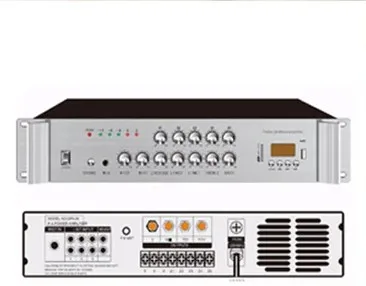
Confirm the zones before anything else
An amplifier serves zones, and the order should be able to name them. How many zones does the building divide into — not rooms, but areas that must be addressable separately or protected separately? Which zones share an amplifier and which need their own? A buyer who cannot answer has an order that is not ready, because the amplifier count, the rack layout and the wiring plan all hang from the zone map. Draw it from the announcement patterns, the way the sector guides on this site describe, and let the hardware follow.
Confirm the load the amplifier will actually drive
The second confirmation is the loudspeaker load: which speakers, how many, in which zones, on what line arrangement. An amplifier is matched against that load, not against the building's floor area or the buyer's sense of the venue's size. This is also where listing titles must not be trusted: the wattage figures inside marketplace listing titles are the seller's listing copy, and the confirmed specification of a specific model is a quotation-stage document. A buyer comparing models should ask for the confirmed figures side by side rather than assembling a comparison from listings.
Confirm the sources and who touches them
List every source the rack must accept: announcement microphones and where they sit, music sources, scheduled signal sources, feeds from other systems. Then note who operates them — a trained technician, a duty officer, a teacher — because the front panel that suits one baffles another. The source list decides whether the order wants a mixing amplifier, which combines source handling and amplification in one unit, or separate amplification behind a mixer worked by an operator. It also decides the small things that become big annoyances: whether an announcement point needs its own input priority, whether music should duck automatically under speech.
Confirm priority and the emergency duty
If the building carries safety messaging, the amplifier's priority behaviour is part of the order, not an afterthought: which source overrides which, what happens to the running programme when the override fires, and whether the override reaches zones that routine announcements are excluded from. Buildings with protected quiet zones — hospital wards, exam halls — need the question answered in both directions: the emergency must get in, and nothing else may. Confirming this before the order is placed costs a paragraph in the inquiry; retrofitting it costs a rework.
Confirm the physical facts
Rack space, ventilation, and where the rack actually lives. Amplifiers are installed equipment with a working life measured in years, and the mundane facts decide much of that life: a rack in a hot cupboard, a rack room that floods its floor in the wet season, a site whose power is unreliable. None of these change which amplifier is right in principle; all of them change what should be ordered around it. Replacement orders carry one more physical fact: the dimensions and connections of the unit being replaced, so the new unit lands in the old one's place without a rack rebuild.
The checklist, condensed
Zones named and mapped. Load listed by zone. Sources listed, with their operators. Priority and emergency behaviour stated. Rack position and conditions described. A buyer who can send those five confirmations with the inquiry will receive a quotation that matches the venue — and will recognise, in its line items, the building they described.
The load calculation, done on one page
Every amplifier order rests on a load calculation, and the calculation deserves to exist on one page where the buyer can see it whole: each zone, its speakers, their tapping, the sum, the headroom, the chosen unit. One page is not a stylistic preference — it is the size at which a mistake remains visible. Errors hide in appendices; on one page, the doubled zone and the forgotten annex announce themselves. Buyers who receive a quotation without that page should ask for it, and buyers preparing their own inquiry can build the page themselves from the room schedule and send it as the inquiry's core, converting the supplier's work from archaeology into checking.
The page also survives the order usefully. At installation it becomes the installer's map; at commissioning, the checklist the levels are signed against; years later, the document that tells a successor what the rack was meant to do. Few project documents earn their keep four times; the load page does, and its absence is felt at every one of those moments.
Questions that expose a weak quotation
Three questions, asked of any amplifier quotation, expose its foundations quickly. Ask which zone the largest unit serves and what its load is: a ready answer means the sizing was done; a pause means it was assumed. Ask what happens when the busiest zone's duty doubles — a festival week, an examination season of constant announcements: the answer reveals whether headroom was a decision or an accident. Ask which single failure would silence the most ground, and what the quotation's answer to that failure is: the reply distinguishes a design that has considered its own fragility from a list that has not. None of the questions requires the buyer to be an engineer; all three require the supplier to have been one.
The questions work because they cannot be answered from a price list. They address the quotation's reasoning, and reasoning is what the buyer is actually purchasing — the equipment is merely its delivery mechanism.
Keeping the order's reasoning alive
The last check costs nothing and protects everything the others established: write the order's reasoning down where the installation team will find it. Which zones each unit serves, what headroom was allowed and why, which failure the spares answer — three short paragraphs in the project file convert the buyer's careful pre-order work into the installer's working knowledge, and into the successor's inheritance years later. Orders whose reasoning evaporates at the purchase are re-litigated at every subsequent fault, usually in the dark, usually at the worst hour. The amplifier was the visible part of the purchase; the reasoning was the valuable part, and it deserves the same delivery care.
There is a shorter version of this whole guide, worth keeping on the wall of whichever office places the orders: count the speakers, tap them honestly, leave the headroom the duty deserves, and let the room the rack lives in have its say. Four sentences of arithmetic and observation, done before the order rather than after the installation, are what separate the amplifier purchases that are forgotten immediately — the highest praise available — from the ones that are discussed for years. Everything else in these pages is commentary on those four sentences.
Related pages

Send an inquiry
Send the five confirmations with your inquiry, and the amplifier side of the order will be specified against your venue, not against a guess.