Karaoke amplifiers
Karaoke amplifiers are a named category in the company's shop range, serving karaoke venues and entertainment rooms where the amplifier works with microphone sources and cabinet speakers in a small, dense setup rather than across a building's zones.
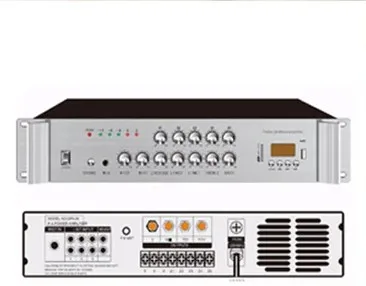
What the karaoke amplifier category covers
A karaoke room concentrates what a broadcast system spreads out: two or more live microphone sources, a music source, and a pair of cabinet loudspeakers in one room, with the balance between voice and music adjusted constantly through the evening. The amplifiers in this category are specified for that work — microphone-first mixing, in a unit sized for a venue rack or counter rather than a building rack room. The company's production lines have long included karaoke cabinet speakers alongside the amplifiers, and the two are usually ordered together.
Karaoke rooms in a larger venue
Karaoke amplifiers most often appear inside a bigger order: an entertainment venue, hotel or leisure site fitting out several rooms at once, sometimes alongside a public address build for the rest of the building. The two systems stay separate — the karaoke rooms run their own amplifiers and speakers, the building runs its broadcast rack — but ordering them together keeps the venue's whole audio list in one quotation and one shipment.
How the karaoke range is ordered
Like the professional power amplifiers, this category is published at category level, with models confirmed at quotation. The useful inquiry states the number of rooms, the cabinet speakers each room will run, and whether the amplifiers are for a new fit-out or replacements in an existing venue — replacement orders should name the units being replaced so the match can be checked.
Tuning a room that sings back
A karaoke room is an acoustic argument between the loudspeaker and the microphone, held a few metres apart. The amplifier's contribution to peace is control: echo and reverb adjustment fine enough to flatter a voice without feeding the loop, microphone channels that can be balanced against the music channels quickly, and limiting that catches the enthusiastic peaks before the loudspeakers complain. Rooms differ in how hard they argue — hard surfaces and low ceilings argue loudest — so the setup that flatters one room can destabilise its neighbour, and per-room adjustment is a feature to ask about rather than a nicety.
Operators learn their rooms' tempers and write the settings down; buyers equipping several rooms at once should ask for that learning to be part of the delivery conversation. The amplifier that can store or reproduce a room's settled settings saves the re-learning at every staff change, and staff change often in entertainment venues.
Heat, hours and the economics of nightly duty
Few amplifier families work as hard as this one: long nightly hours, high ambient temperatures in small equipment cupboards, and programme material that rarely idles. The buying consequence is that reliability figures and thermal design matter more here than in almost any other family on this site, and ventilation of the installation point is part of the purchase whether the buyer plans it or not. An amplifier installed in an unventilated cupboard will teach the lesson expensively; the inquiry should describe where the units will live so the recommendation can allow for the cupboard.
Nightly duty also changes the spares calculation. A venue whose amplifiers earn money every night cannot wait on a repair queue; a shelf spare, swapped in minutes, is worth more than a warranty promise. Buyers equipping multi-room venues should weigh a spare unit into the first order and say so in the inquiry, so the quoted configuration keeps the rooms' settings interchangeable with the spare.
Microphones and music: the two halves of the mix
The karaoke mix is two products sharing one amplifier. The music half wants fidelity and weight; the voice half wants clarity, effects and forgiveness. Units in this family differ mainly in how they balance the halves — how many microphone inputs they carry, how the effects are voiced, how the balance is adjusted in the dark by feel. Venues whose singers bring their own material, and venues running competitions or hosted nights, lean differently on the halves, and saying which kind of venue is being equipped steers the recommendation better than any figure could.
The room's loudspeakers complete the balance: a voice-forward system wants speakers that keep speech intelligible at the back wall without harshness at the front, which is a different ask from a dance floor's. Buyers ordering amplifiers and speakers together should present them as one decision; ordering them in sequence from different conversations risks each being right and the pair being wrong.
Related pages
Send an inquiry
Send the room count and the speakers each room will run, and the category can be narrowed to models for quotation.