PA speakers
The PA speaker families divide by where the loudspeaker has to live: in a ceiling, on a wall, on a pole outdoors, in the ground of a landscaped area, or at the end of a long throw. This page is the map of the speaker side of the catalogue; each family page takes one placement and works through it.
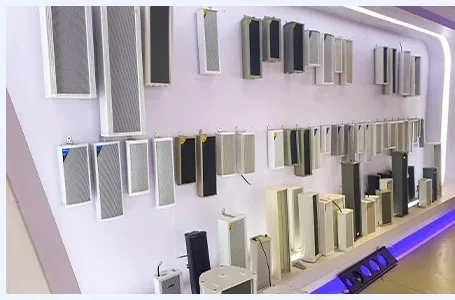
The speaker families by placement
| Family | Placement | Typical ground |
|---|---|---|
| Column speakers | Wall or pole, vertical line | Halls, corridors, outdoor paths and squares |
| Ceiling speakers | Flush in the ceiling | Offices, wards, classrooms, corridors |
| Wall-mounted speakers | Surface on the wall | Classrooms, meeting rooms, shops |
| Garden speakers | In the ground, landscape-blended | Scenic areas, gardens, waterfronts |
| Horn speakers | Pole or structure, long throw | Industrial yards, villages, open ground |
One catalogue model worth naming here
Most speaker selection happens at family level, but one model from the official range is recorded on this page because buyers ask for it by name: the CLS-518, shown in the speaker range on the company's product pages. Like the amplifier models, it is named as listed; buyers who need its confirmed details should ask for them with the inquiry, and buyers who do not know the name should simply order by family and setting — the model follows from those, not the other way round.
Choosing by the room before the model
The order that works is placement, then coverage, then model. Placement is decided by the building: a ceiling that takes flush units, a wall that takes surface units, a pole, a flowerbed. Coverage is decided by the shape of the ground and how far the farthest listener sits. Only then does a model get picked, from the family the first two answers selected. Buyers who start from a model name and work backwards usually discover the placement problem last, when the units are already on site.
Coverage arithmetic buyers can check
Speaker counts quoted without their reasoning cannot be checked, and unchecked counts are where budgets quietly inflate or quietly fail. The reasoning is not complicated: a space's area and ceiling height, the pattern of the chosen family, and the overlap the pattern needs to stay even. Buyers should ask for counts in that form — this many units because this ground, at this height, with this pattern — and should be suspicious of counts that arrive as bare totals. The CLS-518 in this catalogue's ceiling range is a useful anchor for the conversation precisely because its role is so ordinary: the grid unit for standard rooms, counted from the room schedule rather than guessed per floor.
The arithmetic also exposes the rooms that break the standard pattern — the double-height lobby inside an ordinary school, the glass-walled corner office, the corridor that is really a public concourse. Naming those rooms separately in the inquiry, instead of letting them be averaged into the floor's count, is what separates a speaker schedule that commissions cleanly from one that needs a remedial order.
Mixing families inside one system
Most real systems mix speaker families, and the mixing is a design act, not a shopping accident. Ceiling grids carry the rooms; columns carry the lengths; horns carry the yards; garden units disappear into the planting. The points where families meet — the doorway between the ceiling-covered lobby and the column-covered concourse — are where levels and tone must be matched deliberately, because a listener crossing the seam hears any mismatch as a fault in the whole system. Designers handle the seams in the zone plan; buyers should check that the plan they are quoted against has seams drawn on it, and should say where their building's seams are when they inquire.
Mixing also has a maintenance face. Each family in a building is a family the maintenance shelf must cover, and a building that mixes five families for marginal acoustic reasons carries five spares lines forever. The discipline is to mix where the ground demands it and standardise where it does not — a judgement the sector pages illustrate setting by setting.
Listening level: the specification nobody writes down
Every speaker specification implies a listening level, yet the level itself is rarely stated, and unstated levels are a fertile source of disappointment. A system specified by habit for background music will be found wanting the first time it must carry an urgent announcement over crowd noise; a system specified for announcements will be found harsh in the quiet hours it spends on music. The level conversation belongs in the inquiry in plain words: what the system must be heard over, in which hours, in which zones. With that stated, speaker choice and amplifier sizing can both be argued from it; without it, both are habits.
Level also varies deliberately across a good system's zones, and the variation is part of the design rather than an inconsistency. Wards sit lower than concourses; classrooms sit lower than playgrounds; the variation should be written into the zone schedule so that commissioning sets it deliberately and later adjustments preserve it, instead of every zone drifting toward the same level under successive operators' hands.
Related pages
Send an inquiry
Describe the placements and the ground to be covered, and the speaker side of the list can be built family by family.