Intelligent public address systems
The intelligent public address series is built for institutions whose sound runs to a timetable. The host holds the day's schedule — bells, timed announcements, zone programmes — and plays it without an operator standing over it, while still taking live announcements whenever a person needs the microphone.
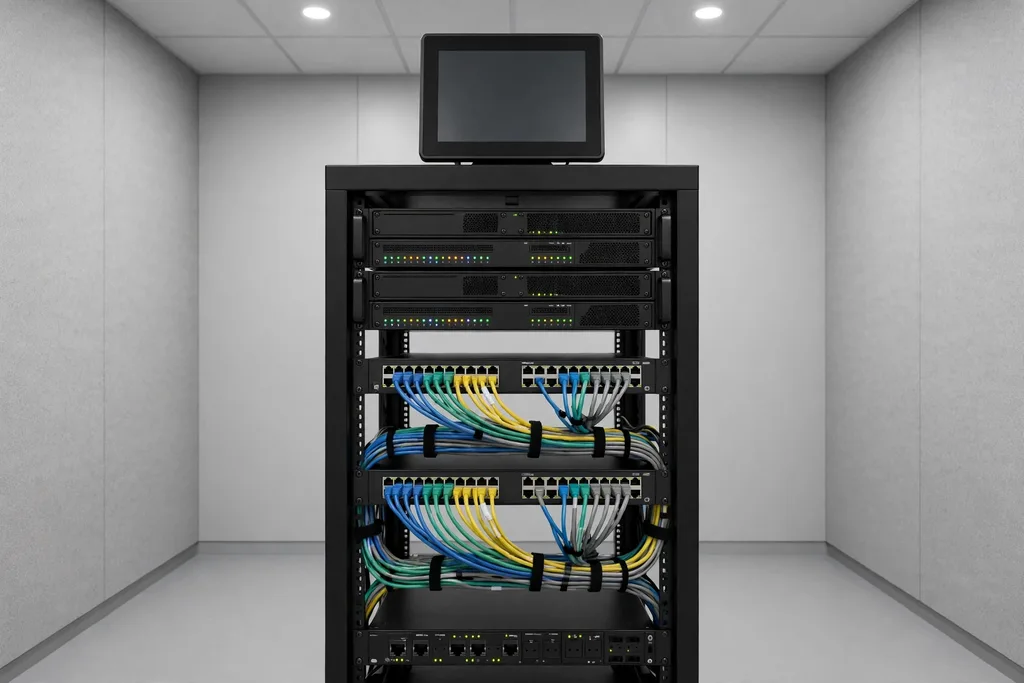
What the intelligent series adds to a public address system
A conventional system amplifies what someone plays or says at the moment they say it. The intelligent series adds the layer that runs when nobody is at the desk: a stored schedule of events, each tied to a time, a zone set and a source. A school day is the clearest case — lesson bells, break signals, lunch announcements and end-of-day messages recur exactly, every day, whether or not the office remembers them — but the same pattern serves factories with shift signals, scenic areas with opening sequences, and any site whose announcements repeat on a rhythm.
Series features buyers ask about first
| Feature | What it does | Where buyers use it |
|---|---|---|
| Timed scheduling | Plays stored events at set times, day by day | Bells, shift signals, opening and closing sequences |
| Zone programming | Different zones run different programmes at the same time | Classrooms against playgrounds, wards against public halls |
| Automatic sequences | Chains announcements and music into a set order | Ceremonies, drills, daily routines |
| Live override | A live announcement interrupts the schedule and the schedule resumes | Urgent messages during a running programme |
Intelligent or IP: the two layers are different questions
Buyers sometimes treat intelligent and IP as alternatives; in this catalogue they answer different questions. IP describes how the sound travels — over the network. Intelligent describes how the programme runs — to a stored schedule. A large campus usually wants both: network carriage to reach scattered buildings, and a scheduled host so the day runs itself. A compact institution with short cable runs may take the intelligent series on a wired build and skip the network layer entirely. The inquiry only needs to say which of the two problems the site actually has.
Planning the schedule before the hardware
The useful document at inquiry stage is the timetable itself: the events of a normal day or week, the zones each event addresses, and the exceptions — exam weeks, holidays, event days — that need their own stored patterns. With that in hand the host and endpoint list writes itself; without it, the hardware can be quoted but the schedule that justifies it stays guesswork. The schools page works through the education version of this planning in detail.
Scheduling as the centre of the design
An intelligent system is designed backwards from its calendar. The calendar states what the site does: the day divided into periods, the week into kinds of day, the year into terms, seasons and holidays, each with its own announcement pattern. Designing from the calendar exposes decisions that equipment-first design hides — how many distinct day patterns exist, which zones obey which pattern, what happens when a special day interrupts the ordinary one. Buyers who can hand over a real calendar, even a rough one, give the configuration a head start that no amount of later adjustment fully replaces.
The calendar also disciplines the zoning. Zones that never differ in their scheduled behaviour are one zone wearing two names; zones that differ only on special days still deserve separation, because special days are when staff are busiest and manual workarounds fail. Reading the calendar against the zone map, line by line, is the single most valuable hour in an intelligent system's design, and it costs nothing but attention.
Automation boundaries: what the system should never decide
Scheduling handles the predictable; judgment must keep the rest. An intelligent system should automate the timetable, the routine background programme and the standard transitions of the day, and it should leave exceptional announcements — the unscheduled, the urgent, the sensitive — to a person at a microphone or console, with the automation yielding instantly. Systems configured the other way, where staff fight the schedule to make an exception, teach their users to distrust the automation, and distrusted automation gets switched off, taking its genuine benefits with it.
The boundary also runs the other way: things humans reliably forget should not be left to them. Holiday silences, examination-period quiet, the seasonal change of a scenic site's programme — these belong to the calendar precisely because they are rare enough to slip memory. A good configuration review sorts every recurring event into exactly one of the two columns, automated or manual, and writes the sorting down where the next administrator can find it.
Growing an intelligent system over time
Intelligent systems tend to grow by accretion: a new building joins, a department starts its own programme, a seasonal event becomes permanent. Each addition is a configuration change, cheap in itself, but the accumulated configuration can drift away from any single person's understanding. The discipline that prevents drift is the same one that built the system: every change enters the calendar document first, and the configuration is audited against it at intervals. Buyers planning a long-lived installation should treat that document as part of the purchase, delivered and updated like any other component.
Growth also argues for choosing the host with spare zone and schedule capacity rather than the host that exactly fits the opening day. The marginal cost of headroom at purchase is small; the cost of replacing a host that a growing site has outgrown is a second installation. The inquiry for an intelligent system should therefore name the growth the buyer already foresees — planned buildings, planned programmes — so the headroom can be sized to it.
Related pages

Send an inquiry
Send the timetable the system must run — events, times and zones — and the series can be specified against it.