Mixing amplifiers
Mixing amplifiers combine the mixer and the amplifier in one rack unit: several sources come in, the balance between them is set on the front panel, and the loudspeaker zones are driven from the same box. Two models from the range are named on this page, as listed in the company's shop.
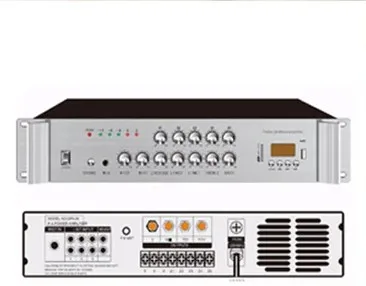
The named models: F-6150AU and F-6350AU
The F-6150AU is listed in the shop as a mixing amplifier for professional sound systems. The F-6350AU is listed as a rack-format mixing public address amplifier. Both sit in the part of the range where a single unit is expected to run a small to mid-sized installation's whole programme — announcements, music and scheduled sources mixed at the rack. Ratings that appear inside shop listing titles are the seller's listing text; confirmed specifications for either model are supplied at quotation stage, and buyers comparing models should ask for the two side by side rather than work from listing titles.
When a mixing amplifier is the right shape
| Situation | Why the combined unit fits | What to check instead |
|---|---|---|
| One rack runs the whole site | Mixer and amplifier in one unit keeps the rack small and the wiring short | That the source count fits the front panel |
| Announcements and music share the system | The balance is set once, on the unit, by the operator | Priority handling for urgent announcements |
| A separate mixer would sit idle | Most small installations mix at fixed settings for long stretches | Whether any source needs processing the panel lacks |
Mixing amplifier or separate power amplifier
The split is about where the mixing happens. If the sources are few and their balance is stable, the combined unit is the simpler and cheaper rack. If the programme is performed — a stage, a ceremony, a venue whose levels are ridden live — the mixing belongs in a mixer worked by an operator, with power amplifiers behind it. The blog on this site works through that choice in the order a buyer meets it, and the power amplifier category page covers the other side of the split.
Reading the F-6150AU and F-6350AU as a class
The two named models in this line are best read as representatives of a class rather than as a complete menu: rack-format mixing amplifiers for the small-to-mid-sized installations that make up most of public address work — the school block, the community hall, the mid-sized commercial floor. Reading them as a class means reading their arrangement: sources gathered at the front, zones fed from one point, the controls a non-expert can be taught in an afternoon. A buyer whose site fits that shape can treat the models as the shortlist; a buyer whose site outgrows it in any direction — many more zones, networked buildings, performance duty — should treat them as the baseline the larger answer is measured against.
That reading also clarifies the comparison buyers bring to the inquiry. The useful question is rarely which of the two, but what the site's source list and zone count do to the choice: sources at the edge of a unit's provision argue for stepping up a class, while a comfortable fit argues for staying and spending the difference on the speaker side, where it is heard.
The source list as a design document
A mixing amplifier is chosen by its inputs more than by its outputs. The source list — every microphone position, every programme feed, every local input a room's users expect to plug into — is therefore a design document, and writing it completely is the buyer's most valuable contribution to the specification. Sources forgotten at this stage return as adapters, borrowed inputs and quiet resentment; sources listed that never arrive cost a little unused provision, which is the cheaper error by far.
The list should record not only what plugs in but who operates it. A source used by trained staff can live behind a menu; a source used by whoever books the hall must be findable by touch, labelled in the room's own words. Mixing amplifiers differ in how their front panels serve the second kind of user, and for community and institutional spaces that difference is worth more than a row of extra features.
When one box is the right architecture
The integrated mixing amplifier persists because a large class of sites is genuinely one room deep: one space, one operator position, a handful of sources, a few speaker zones at most. For those sites the single box is not a compromise but the correct architecture — fewer interconnections to fail, one unit to understand, one unit to spare. The architecture stops being right when the site's shape changes: a second room with its own programme, a remote source that cannot be wired home, a schedule that must run while the operator is elsewhere. Buyers should locate their site on that line honestly; both errors — the over-built rack and the outgrown box — are common, and both are visible in advance.
Growth deserves a forward look in the same judgement. A hall planning an extension, a school expecting a new block, a venue adding an outdoor area — each turns today's correct single box into tomorrow's limitation. Where the growth is funded and dated, buy for it now; where it is merely hoped for, the mixing amplifier's modest cost makes it the right purchase anyway, redeployable to a smaller duty when the larger system arrives.
Related pages
Send an inquiry
Name the model or describe the sources and zones, and the mixing amplifier side of the order can be quoted.