Mixing amplifier or power amplifier: matching the amplifier to the venue
Buyers often treat the mixing amplifier and the power amplifier as cheaper and dearer versions of one thing. They are different answers to one question — where does the mixing happen? — and this guide works through how a venue's programme answers it.
The question underneath the choice
Every amplifier order sits downstream of a mixing decision. Several sources — microphones, music, scheduled signals — must be balanced against each other before they are amplified. That balancing happens either inside the amplifier, on its front panel, or in a separate mixer whose output the amplifier then drives. A mixing amplifier is the first answer in one box. A power amplifier is the second half of the second answer. Neither is a compromise version of the other; each assumes a different account of who runs the programme and how much it changes while it runs.
The mixing amplifier's ground
Choose the combined unit where the programme is stable. A school hall whose sources are an announcement microphone, a music feed and the bell system, balanced once and left at those settings for a term. A place of worship whose two microphones and organ feed sit at fixed levels. A small venue whose operator is also its caretaker, for whom one panel with a handful of controls is a feature, not a limitation. In these settings the separate mixer would be bought, installed, set — and then ignored at exactly the settings the mixing amplifier offers natively, having cost more and added a box, a set of connections and a failure point to no purpose.
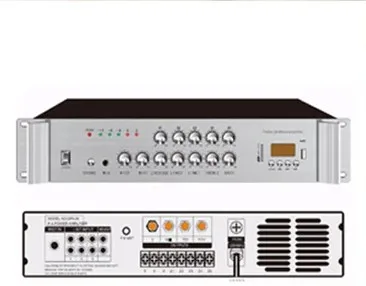
The mixing amplifier page in this catalogue covers the named models of the line, which sit in that territory: rack-format units for small to mid-sized installations. Buyers comparing models should compare against their source list and zone count, which is what that page's checklist is for.
The power amplifier's ground
Choose the separate path where the programme is performed. A stage, a ceremony, a venue whose levels are worked live by an operator who is listening and riding the balance as the event unfolds. There the mixer is an instrument, not a setting: it belongs in the operator's hands, with the facilities a performance needs, and the power amplifiers behind it are specified purely against the loudspeaker load. Professional power amplifiers are built for that half of the work — drive, at level, for hours — and asking a mixing amplifier to front a performed programme short-changes both the operator and the audience.
The middle cases, decided honestly
Many venues sit between: a hotel function room, a school with a real performance programme, a leisure venue with karaoke rooms. The deciding question is who touches the levels, and how often. If the honest answer is that settings are adjusted a few times a year, the mixing amplifier serves, and any performance-grade need can be met by hiring or by one performance space specified separately. If the answer is that an operator works the programme weekly, the separate path pays for itself in the first season. Buyers should be suspicious of the answer that specifies performance equipment for a caretaker's venue out of caution: the extra complexity does not sit idle, it sits between the caretaker and the announcement that must work first time.
Cost, rack and failure shape
The combined unit is one box: less rack space, fewer connections, one thing to maintain, and one thing whose failure silences the system. The separate path spreads the risk and the cost across two devices and lets either be replaced or upgraded alone. For a single-room installation the arithmetic favours the combined unit clearly. For a venue whose programme will grow — more sources, a second space, a recording feed — the separate path's ability to grow the mixer without touching the amplification is worth more than the first order's saving. Neither consideration outranks the programme question; they break ties, they do not make the decision.
Putting it in the inquiry
State the sources, state who operates them and how often the balance changes, and state the zones or loudspeakers the amplification drives. With those three facts, the choice usually makes itself — and where it genuinely does not, it can be discussed against the venue rather than against catalogue abstractions.
Two installations that chose opposite answers
Consider a community hall whose programme is meetings, classes and the occasional celebration, all run from one cupboard by whoever booked the room. Its sources are a pair of microphones, a music feed and a laptop point; its speakers are one hall set and a small foyer zone. A separate power stage would add a mixer it does not need, connections its operators cannot check, and cost that buys nothing the hall will ever request. The mixing amplifier is not the budget answer here; it is the correct one, and its correctness shows every week in a system that any committee member can run. Now consider the arts venue across town: a technician, a mixing desk that is the building's heart, programme that changes nightly, and loudspeaker zones that must be rebalanced per production. Feeding that desk into a mixing amplifier would strand its capabilities and fight its operator; the power amplifier's dumb obedience is exactly the virtue required. The two buildings' right answers are opposites, and both are obvious once the operation — not the budget — is described.
The exercise generalises: describe who touches the system, how often the programme changes, and what the sources are, and the architecture usually names itself. Buyers caught between the two should write that description before comparing any prices, because the comparison means different things under the two architectures.
The hybrid middle, and its honest limits
Between the pure answers sits a hybrid that tempts many buyers: a mixing amplifier for the everyday zones, with a power stage added where the main space demands it. The pattern is legitimate — school halls with performance ambitions and houses of worship with concert programmes live there happily — but it should be chosen knowingly, because it operates as two systems wearing one rack: two control philosophies to teach, two spares lines to hold. Where the main space's demands are occasional, the hybrid earns its complexity; where they are weekly, the honest answer is usually the full separate chain for the main space and no apology. The deciding question is how often the flagship duty actually happens — a fact about the buyer's calendar, not about any amplifier.
Whichever pattern is chosen, the inquiry that states the calendar alongside the source list will be answered in the right architecture. That, in the end, is the whole argument of this guide: the choice is made by the operation, and the operation is the buyer's to describe.
Related pages
Send an inquiry
Send the source list and say who runs the programme, and the amplifier side can be matched to the venue.