Public address system manufacturer
This is the manufacturer's own catalogue. The company develops and produces its public address range in-house — systems, amplifiers, loudspeakers and control gear — and this page sets out what that means for a buyer: one specification table across a system, and production capacity stated in the company's own figures.

Own development, own production
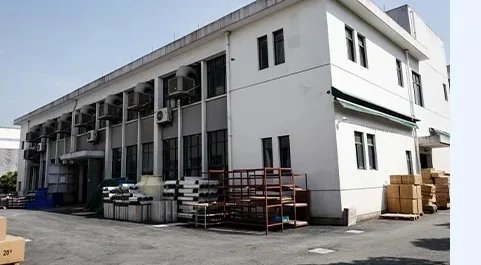
The company states its position plainly: it is one of the manufacturers realising one-stop production for public address and professional audio products, independently developing and manufacturing its range. For a buyer, the practical consequences are specific. A system specified across the catalogue is specified by the people who designed its parts to agree. A model question reaches the model's makers. And an order that needs the equipment adapted — the OEM and ODM work described on the custom page — is a conversation with the production side, not a request relayed to it.
Production in the company's own figures
| Figure | As the company states it |
|---|---|
| Branch factories | 4 |
| Plant area | Over 20,000 m² |
| Production lines | 12 |
| Annual capacity | 800,000 electronic units |
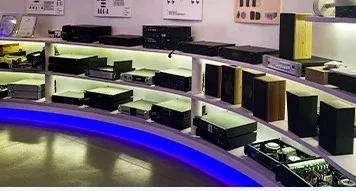
The production lines behind those figures build the catalogue's electronic core: public address power amplifiers, intelligent PA controllers, network-based PA devices and the peripherals around them, alongside the professional lines for stage power amplifiers and karaoke equipment. Speaker production completes the range, so a full system — host to loudspeaker — is manufactured inside one operation.
What factory-direct specification changes
Buying from a reseller, a buyer chooses among what the reseller chose to stock. Buying from the manufacturer, the buyer chooses from the range as published — dozens of series — and can ask the questions a range answers: which amplifier series the speaker family was designed against, which host the endpoints expect, what the intelligent layer does to a wired build. System orders use that directly: the site description comes in, and the specification that goes back is drawn from one coherent catalogue rather than assembled across brands.
The manufacturer's sectors
The company's published solution sectors — education, scenic and cultural tourism, industrial parks, hospitals and medical care, townships and villages — describe where its systems are concentrated, and the sector pages follow them. A buyer in one of those sectors is buying into the manufacturer's most-practised patterns; a buyer outside them is buying the same catalogue with the same factory behind it, specified from first principles rather than from a sector pattern.
Inside the figures on this page
The scale figures stated on this page — four branch factories, a plant area over twenty thousand square metres, twelve production lines, an annual capacity of eight hundred thousand electronic units — are the company's own published numbers, and a buyer is entitled to ask how they compose. Which lines serve which families, where the electronic assembly sits relative to the speaker production, what share of capacity the export catalogue draws on: those are fair questions with factual answers, and they are the questions that turn a figure from a brochure line into an understanding of the factory behind an order. The inquiry route carries such questions as readily as it carries item lists.
Reading figures well also means knowing what they cannot say. Capacity states what a factory can make, not what a particular order will experience; the order's experience is set by its own position in the production conversation — its families, its quantities, its season. Buyers who need delivery behaviour described should ask for it in those terms, against their actual list, rather than inferring it from totals.
Product development as a buyer's signal
A manufacturer's catalogue carries evidence of its development habits: whether families evolve in coherent steps, whether control and electronics advance together or drift apart, whether older lines remain supported after their successors arrive. Those habits matter to a buyer more than any single model's merit, because the buyer is purchasing into the catalogue's future — the replacement unit in five years, the extension in eight. Reading a range for its coherence, and asking how discontinued items are supported, is due diligence that costs one message and protects a decade.
The same reading applies to documentation and configuration tools, which are development products in their own right. A manufacturer that maintains them carefully is telling the buyer how it will behave about everything else; one whose documents contradict its own catalogue is telling the same story in the other direction. Either way, the buyer who reads before ordering knows more than the figures ever state.
The factory behind private arrangements
For buyers considering own-brand or long-term arrangements, the manufacturer's organisation matters as much as its lines: how engineering changes are controlled, how a buyer's variant is kept distinct from the catalogue stream, how quality is held steady across a long production relationship. Those questions are answered in conversation rather than on pages, but they begin from what pages can show — a range coherent enough to vary deliberately, production organised enough to keep variants separate. The custom systems page takes up the arrangement side of that conversation; this page confines itself to the standing fact that the organisation behind it is a single manufacturer with its own research and production, which is the precondition everything else rests on.
Buyers at that level of intent should expect the conversation to be mutual. A manufacturer being asked to hold capacity, variants and development attention for a partner will ask its own questions — about volumes over time, about the partner's markets and support — and the quality of those questions is itself evidence about the factory's seriousness.
Related pages
Send an inquiry
Bring the list or the site to the factory desk — the specification comes back from the people who make the range.