Professional power amplifiers
The professional power amplifier category covers the stage and venue end of the amplifier range — power amplifiers built for professional sound reinforcement rather than for building broadcast. It is a named category in the company's shop and one of the production lines its own capacity description lists.
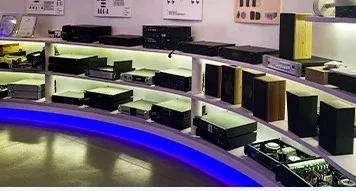
What the professional power amplifier category covers
Where the public address series is built around zones and announcements, the professional power amplifiers are built around the loudspeaker load of a performance or venue system: driving professional audio loudspeakers at working levels, in racks that may move between venues or sit in a venue's permanent installation. The company's own history starts in this category — its first products were professional stage stereo amplifiers — and its production lines still list professional power amplifiers alongside the broadcast range.
Power amplifiers and public address amplifiers are different tools
Buyers new to the catalogue sometimes ask why two amplifier categories exist. The division is the job, not the quality. A public address amplifier is specified by zones, sources and priority handling; it is a distribution device. A professional power amplifier is specified by the loudspeakers it drives and the programme it must reproduce at level; it is a reinforcement device. A venue can need both — power amplifiers on the stage system, a broadcast rack for the building — and the inquiry should say which side of the building each unit belongs to.
How this category is ordered
The category is published at category level: the shop lists the family, and individual models are confirmed at quotation against the buyer's loudspeaker list. That is deliberate. A power amplifier quoted without its load is a guess, so the useful inquiry names the speakers the amplifiers will drive, the setting they will work in — fixed installation or moving rig — and the quantities involved.
Headroom, stated plainly
Headroom is the distance between what a performance actually asks and what the amplifier can deliver, and it is the most argued-over quantity in this family. Too little, and the peaks that carry excitement in music arrive clipped and harsh; too much, and the buyer has paid for capacity that exists only on paper. The honest way to settle it is from the programme material and the room: speech-forward reinforcement needs less than full-range music at event levels, and a reverberant hall asks differently from an absorptive theatre. Any recommendation made without those two facts is a guess wearing a number.
Headroom also has a protective side. An amplifier working well inside its capacity runs cooler, lasts longer and treats its loudspeakers gently; one working at its edge converts every programme peak into stress. Where a venue's programme is growing — a bar adding live nights, a hall taking larger events — buying the headroom in advance is usually cheaper than replacing the amplifier when the programme outgrows it.
Matching amplifiers to loudspeaker loads in performance rigs
Performance loudspeakers present their amplifiers with loads that vary with the programme, and the matching conversation is about behaviour under that variation: stability into the load, control of the cone at low frequencies, and how the pairing behaves at the crossover points of a multi-way system. These are system questions, answered by listening and measurement rather than by catalogue figures, which is why experienced buyers audition pairings or take them on the word of engineers who have. The inquiry route here supports that: describe the loudspeakers and the programme, and the recommendation can be argued rather than merely asserted.
The same discipline applies in reverse when the loudspeakers are the variable: an amplifier with generous stability margins forgives a wider range of loads, which matters to rental and touring buyers whose cabinets change by engagement. Fixed installations can optimise the pairing tightly; mobile rigs should optimise for forgiveness, and the two optimisations lead to different units from the same family.
Duty cycles: the house rig against the touring rig
A house rig and a touring rig ask opposite things of the same family. The house rig values quiet fans, rack manners and decade-long consistency; it will be installed once and expected to disappear into the building's life. The touring rig values weight, connector robustness and survival of handling; it will be installed a thousand times and expected to forgive all of them. Buyers should say which life they are buying for, because an amplifier perfect for one is merely adequate for the other, and the difference shows up in details — handle design, connector choice, fan behaviour — that headline figures never mention.
Mixed fleets, where a venue hires in extra amplification for large events, add a third pattern: the hired units must integrate with the house system quickly, which argues for the house rig being built from widely understood, conventionally behaved units. Compatibility with the hire market is a real specification, and buyers in event venues should state it in the inquiry alongside the electrical facts.
Related pages
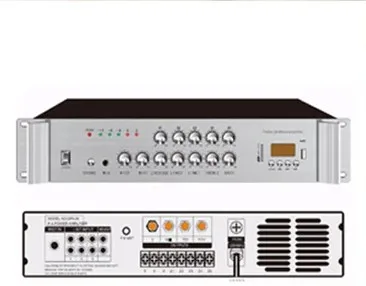

Send an inquiry
Send the loudspeaker list the amplifiers must drive, and the category can be narrowed to models for quotation.