IP public address systems
IP public address equipment moves the sound over the site's data network instead of dedicated speaker cable. A host at the control point serves networked terminals and speakers across the building or the grounds, which is what makes very large, scattered sites practical to cover.
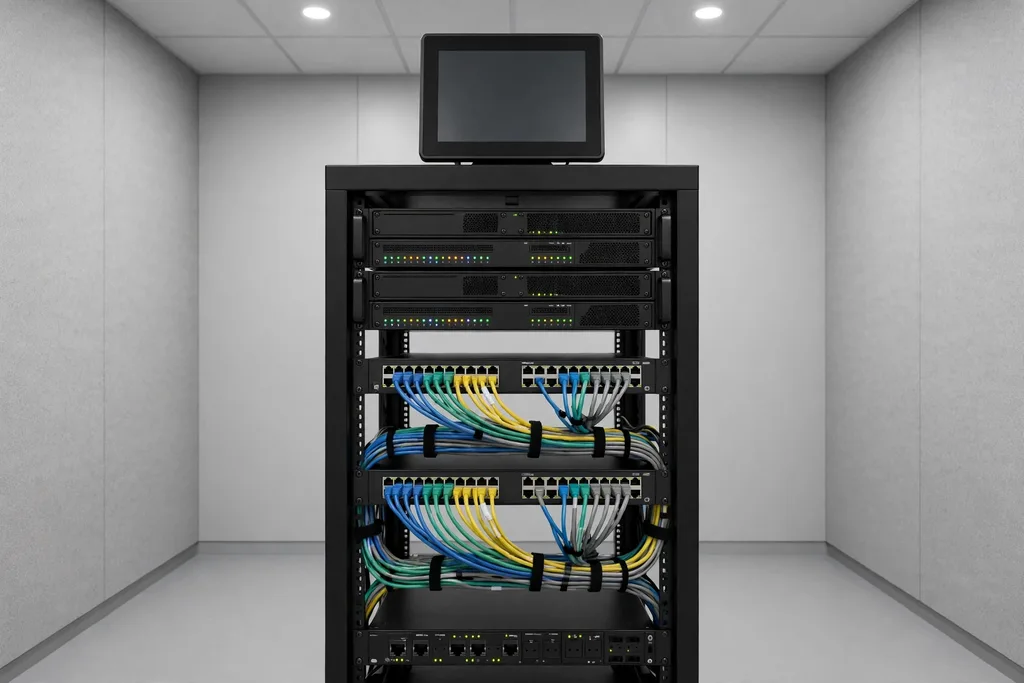
What the IP network public address equipment family includes
The family is the network layer of the catalogue: the IP broadcast host and its peripherals, network terminals that turn network audio back into sound at the point of use, and the networked loudspeakers and amplifiers that serve each zone. It sits above the speaker families rather than replacing them — ceiling speakers still cover corridors, waterproof columns still cover the grounds — but the signal reaches them over the network, so a new zone is a network point, not a new cable run from the rack room.
Where a network build earns its cost
Three site shapes make the case on their own. Multi-building sites, where speaker cable between buildings is the expensive and failure-prone part. Sites that will grow, where adding a building or a floor should mean adding endpoints rather than re-cabling. And sites whose zones change — a school whose timetable shifts by term, a scenic area whose routes open seasonally — because a network system's zoning lives in configuration, not in the wiring. On a compact single building none of this bites, and the amplifier-and-speaker build on the systems page is the straighter answer.
How zones and schedules run on the network
| System task | How it is handled | Typical use |
|---|---|---|
| Zoned announcements | Any zone or group of zones addressed from the control point | Calling one department, floor or garden without disturbing the rest |
| Scheduled programmes | Timed sequences stored at the host and played automatically | School bells, opening and closing announcements, timed music |
| Background music | Programme sources distributed to selected zones at set levels | Public areas, lobbies, scenic paths |
| Emergency-linked broadcast | Priority announcements override the running programme | Evacuation and safety messaging across the whole site |
Because the endpoints are networked, the control point can sit wherever the network reaches — the duty office rather than the rack room — and a second control point is a configuration question, not a construction one. For buyers weighing a network build against a conventional wired one, the comparison page on this site works through the differences in cabling, zoning and expansion without favouring either.
What the network has to provide
An IP system borrows the building's data network, and the borrowing has terms. Endpoints need network drops where speakers must live, which is rarely where the cabling plan originally put them; switches need capacity for the endpoint count at announcement peaks, not at idle; and the audio traffic deserves its own segment or priority treatment so a busy file transfer never competes with an evacuation message. None of this is exotic networking, but it has to be asked for explicitly, because a general-purpose installation delivered without the conversation will treat an announcement endpoint like any other socket.
Power is the other half of the borrowing. Network endpoints are commonly powered through the network cable itself, which removes local power supplies from ceilings and poles and puts the system's endurance in the switch room, where backup power is easiest to arrange. Buyers should settle, before ordering, which parts of the system must keep working when mains power fails, and confirm the network design carries those parts. An IP system specified that way is more resilient than a wired one; specified casually, it inherits every weakness of the network it rides on.
Addressing, naming and living with the configuration
In a network system the configuration file is, in effect, the installation. Zones exist because the configuration says so; schedules fire because it stores them; an endpoint answers to the name it was given. That makes naming a real design task rather than an afterthought: endpoints named by building, floor and room can be re-zoned by a stranger in minutes, while endpoints named by delivery order defeat every later administrator. Buyers taking over a site should ask for the naming convention and the stored configuration as part of the handover, alongside the hardware list.
The same property makes change cheap, and cheap change changes how buyers should think about the first installation. A wired system punishes tentative zoning for the building's whole life; a network system lets the zoning be revised after the first term of use, when the site has shown how it actually behaves. The sensible strategy is to wire generously — endpoints and drops where growth is plausible — and configure conservatively, redrawing zones as the evidence arrives.
Where IP earns its cost, and where it does not
The network architecture earns its premium where distance, dispersion or change dominate: campuses, multi-building institutions, villages, phased developments, any site whose map will not sit still. Its costs concentrate in configuration and network preparation rather than in cable and labour, so the advantage grows with every additional building the system spans. A single compact building with a stable layout gains less: the endpoints still simplify installation, but the flexibility that justifies the architecture may never be exercised.
Honest comparison also counts the skills each architecture needs afterwards. A conventional system can be serviced by any competent audio electrician; a network system occasionally needs someone who reads a switch configuration as comfortably as a wiring diagram. Institutions with an IT function absorb that easily. A lone site manager without one should weigh it, and the comparison page on this site works through the same trade-offs from the buyer's side of the table.
Related pages
Send an inquiry
Send the zone list and the schedule the system must run; the network equipment and endpoints can be listed against it.