Column speakers
Column speakers are tall, slim loudspeakers that spread sound along a line rather than from a point, which makes them the natural choice for long spaces: halls, corridors, concourses, paths and squares. The catalogue carries the family in its professional series and in the waterproof outdoor series.
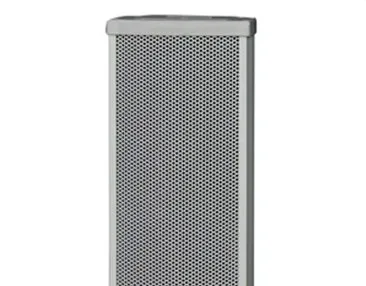
What the column speaker family covers: indoor lines and the S Series
The family's centre is the aluminium column: a narrow enclosure holding a vertical line of drivers, mountable on a wall or a pole, visually quiet against a building. The shop lists an S Series aluminium column speaker for public address systems by name, and the family around it covers the standard indoor and sheltered placements. Buyers who know the name can list it; buyers who do not should describe the throw and the mounting, and the series follows. Outdoor work that faces weather belongs to the waterproof series, which has its own page.
Why a line covers long ground better than a point
A point-source speaker gets loud near itself and quiet quickly with distance, so covering a long hall from one end means the near listeners are blasted or the far ones strain. A column's vertical line throws the sound forward in a flatter pattern: the level falls off more gently along the throw, and the vertical spread stays tight, which also keeps sound off ceilings and floors that would muddy it. That is the whole reason the family exists, and it is why columns are specified by the length of the ground they must cover rather than by the size of the room on a plan.
Column speakers against ceiling speakers
| Question | Column speakers | Ceiling speakers |
|---|---|---|
| Shape of ground | Long and directional: halls, paths, corridors | Even and local: rooms covered from above |
| Mounting | Wall or pole at one or both ends of the throw | Flush in the ceiling, spread across it |
| Coverage pattern | A controlled forward throw | Overlapping pools of sound below each unit |
| Outdoor use | Yes, in the waterproof series | Sheltered positions only |
The comparison page on this site works through the same choice with worked settings — a school hall, a corridor, a covered walkway — for buyers deciding between the two families for a specific space.
Throw, explained by walking
The column's throw is best understood by walking it. Stand at the column and walk its length: the level falls away gently, the speech stays clear, and the far end — the design's whole point — still understands every word. Now walk the same length across a ceiling grid's territory and the experience is different: loud and quiet pools, clarity that comes and goes. Neither is better in the abstract; they are different geometries for different ground. The column owns the geometry of length, and every space whose ground extends in one direction — corridor, concourse, nave, covered walkway, queueing hall — is a candidate for it.
Walking also reveals the column's constraint: its coverage has an edge. Step sideways out of the beam in a wide space and the sound thins quickly, by design — the energy was spent on the length, not the width. Wide ground therefore takes columns in ranks or takes a different family, and the honest specification says which, rather than asking one column to be wide as well as long.
Mounting height and tilt: the two adjustments that matter
A column's performance is set largely by two decisions at installation: how high it sits, and how far it tilts toward its ground. Too high, and the beam overshoots the near listeners; untilted, and it wastes its far energy on the end wall. The decisions interact with the throw's length, which is why the specification conversation for columns always returns to the same three facts — the length to be covered, the mounting position available, and the height the building permits. Buyers who supply those three facts get a recommendation that can be installed as quoted; buyers who supply only the length get a unit and a hope.
Tilt has a second use worth knowing: in reverberant lengths, a slightly steeper tilt keeps energy off the far wall and buys clarity that no equalisation can recover later. Installers who understand the family's behaviour will set tilt by the room rather than by habit, and buyers supervising an installation should ask to hear the result walked, not merely measured at one point.
Columns in reverberant architecture
The spaces that need columns most — stone halls, high naves, glass concourses — are the spaces where sound misbehaves most, because every surface returns it late and loud. The column's tight vertical pattern is the countermeasure: energy is sent along the listeners and withheld from the ceiling and floor, so less of it returns to confuse the speech. This is why the family is specified so often for worship and ceremony spaces, where the architecture is both the reason for the building and the enemy of its announcements — and why, in such spaces, the column's placement deserves more design time than any other single decision in the system.
Reverberation also disciplines quantity. The instinct to add units until a difficult hall sounds full defeats itself: every added source adds its own reflections. The better route is usually fewer, well-aimed columns and patience at commissioning — a lesson buyers can apply when comparing quotations, where the longer speaker list is not necessarily the more competent one.
Related pages
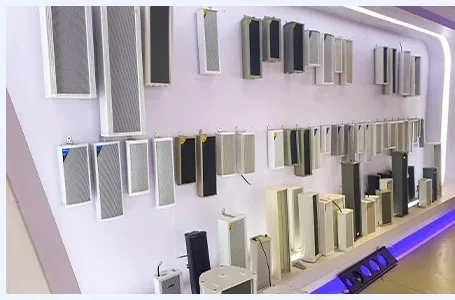
Send an inquiry
Give the throw lengths and mounting positions, and the column side of the order can be specified.