Central control systems
Central control systems are the hosts and peripherals that let one operator run a venue's equipment — audio, displays, sources and room functions — from a single point. In the company's taxonomy the group sits alongside the matrices, which move the signals the control system directs.
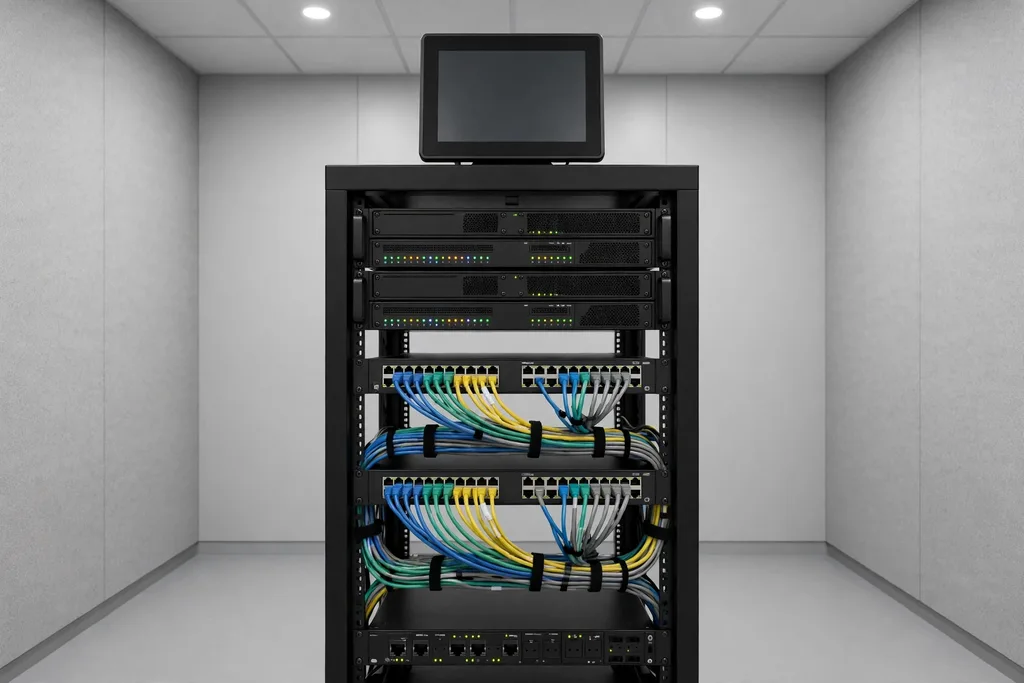
What the central control family covers: hosts and peripherals
The family has two halves. The central control host is the brain: the unit that holds the venue's control logic and presents it to the operator, usually through a panel or a screen at the control position. The peripheral equipment is everything the host talks to — the interfaces, relays and converters that connect the controlled devices. A specification names both halves: a host without its peripherals is a promise, and peripherals without a host are a pile of interfaces.
Where central control is specified
The family appears wherever one room or venue runs several systems that must behave as one: a conference venue whose displays, sound and sources change together between sessions; a school hall whose performance and assembly setups are recalled rather than rebuilt; a cultural venue whose public areas are run by a small staff from one desk. In the catalogue's own projects the group pairs most often with the conference and public address families — control hosts in the rack room, matrices in the signal path, the PA system under the same operator's hand.
Control and matrix are separate purchases
Buyers occasionally fold the two groups into one line on an inquiry, and the quotation then has to unpick them. The control system decides and commands; the matrix routes the audio and video signals between sources and destinations. A venue with many sources and rooms needs the matrix sized first; a venue with few sources but many behaviours needs the control side specified properly. The matrix page covers the routing half; this page's family is the deciding half.
One point of command, and its responsibilities
Central control concentrates a site's audio and media decisions at one position, and concentration creates a responsibility as well as a convenience: the operator at that point speaks for the whole site. The design questions follow from that. Who staffs the position, and what may they interrupt? Which sources live there permanently, and which arrive from rooms? What does the position do when its operator is absent — hold the schedule, fall silent, or hand control to a room? A central system specified without those answers is a piece of furniture; specified with them, it is the site's voice, organised.
The physical position deserves the same forethought: a control point the operator can actually occupy during an event, with sight or monitoring of the spaces being addressed, situated where announcements can be made without the operator's own voice competing with a loud room. Reception desks and security posts often inherit the role by default; whether they can carry it is a question to settle in the design, not to discover at the first ceremony.
Control surfaces: designing for the operator who exists
The finest control architecture fails if its surface defeats its operator. Institutional control points are staffed by whoever is on duty, which argues for surfaces that present the frequent acts — the scheduled override, the zone announcement, the volume correction — as single obvious actions, and bury the rare and dangerous ones behind deliberation. Buyers should name the operating reality in the inquiry: trained audio staff, or a rotating desk team; daily ceremony, or occasional use. The same underlying peripherals arrange themselves very differently on the surface for those two worlds, and the arrangement is a purchasable decision.
Labelling in the site's own vocabulary completes the surface. Zones named as the site names them — the hall, the north wing, the coach bays — are operable under pressure; zones named by installation order are a puzzle at the worst moment. Providing the site's own names, exactly as staff use them, is a small contribution to the inquiry with an outsized effect on the delivered system.
Peripherals and the edge of the system
A central host is judged by its edges: the paging microphones in the rooms, the local inputs where a space plugs in its own source, the interfaces to the site's other systems. Each peripheral is a place where the central design meets a local habit, and the meetings are where specifications fray. The disciplined approach inventories the edges first — every position that originates or receives, every local habit that must survive centralisation — and lets the host be chosen to serve the inventory, rather than discovering the edges after the host has fixed them. Buyers with existing local equipment should list it in the inquiry, marking what must be kept and what is merely present.
Centralisation should also be allowed to stop where it stops helping. A remote room with a fully local life — its own programme, its own operator, no announcements shared with the site — may belong outside the central system, connected only by an emergency path. Deciding that boundary deliberately, room by room, produces systems that feel designed; absorbing everything by default produces systems that feel occupied.
Related pages
Send an inquiry
List the equipment to be controlled and the behaviours to recall, and the control side of the venue can be specified.