PA equipment
This index gathers every equipment family in the catalogue on one page: the systems, the amplifiers, the loudspeakers and the control gear. Each family has its own page with the range described at family level; this page is the map buyers use to check nothing in a system list has been left out.
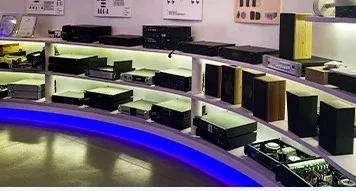
The equipment index, family by family
| Family | What it covers | Start here if |
|---|---|---|
| Public address systems | Complete broadcast builds and their architectures | The project is a whole site, not a parts list |
| Amplifiers | Public address, professional power, karaoke and mixing series | The rack is being specified or replaced |
| Loudspeakers | Column, ceiling, wall, garden and horn series | Coverage and placement are the open questions |
| Central control | Control hosts, peripherals and signal matrices | Several systems in a venue must run from one point |
| Conference audio | Conference systems at category level | The room and the table are the project |
Reading the catalogue the way a system is built
A working system reads down the index in order. The system family decides the architecture — network or wired, scheduled or live. The amplifiers are then chosen against the zones the architecture creates. The loudspeakers are chosen against the rooms and outdoor areas inside each zone. And the control gear, where a venue runs more than announcements — displays, sources, conference rooms — ties the rest together. Reading in that order keeps the commonest specification error away: loudspeakers chosen first, against no amplifier or zone plan, then forced into a system they were not picked for.
Catalogue range and project orders
The company's range runs to dozens of series, and most project orders draw on several families at once. Nothing here is priced per page: equipment is quoted against an item list, because the same amplifier sits at a different price in a single-site order and in a programme of sites. Buyers replacing one failed unit and buyers equipping a new building use the same index — the difference is only the length of the list they send.
Reading a mixed equipment list
Equipment lists assembled from several projects at once are where specification errors breed. A list that mixes architectures — network endpoints beside conventional amplifiers, speakers of one voltage system beside another's — may be a deliberate design or an accident of accumulation, and the two look identical on paper. The checking habit that separates them is to trace each item to the zone it serves: every amplifier to its areas, every speaker to its position, every control unit to the point it commands from. Items that trace nowhere are either spares, which should be labelled as such, or mistakes, which are cheapest while the list is still a list.
Quantities deserve the same tracing. Speaker counts derived from room schedules behave differently from counts estimated per floor; amplifier quantities follow zone counts, not building counts. A quotation prepared against a traced list will differ from one prepared against raw quantities, and the difference is usually the traced one being smaller and right — the untraced list quietly double-counts the corridor that appears in two departments' schedules.
Spares, attrition and the second order
Outdoor and high-duty items attrit. Horn speakers on exposed poles, garden units in irrigated ground, amplifiers running long daily hours in warm plant rooms — a sensible first order carries spares for the positions most likely to fail, sized to how long the site can tolerate that position being silent. A school corridor speaker can wait a week; an evacuation route's cannot. The spares conversation is therefore a priority conversation, and it belongs in the first inquiry rather than in the urgent message sent after the first failure.
The second order is also where range consistency pays. Replacements bought years later from the same families match the installed units in behaviour and mounting, so a failed speaker's successor does not announce itself by sounding different from its neighbours. Buyers building for a portfolio of sites gain the same effect at larger scale: one spares shelf serving several properties, because all of them draw on the same equipment families.
How equipment families map to a bill of quantities
A bill of quantities for public address work reads differently from other trades' bills, because the same physical item can be a component of a system or a product in its own right depending on the line it sits on. The reading habit that keeps orders clean is to group the bill by system first and family second: this building's zones, served by this host, through these amplifiers, into these speakers. Grouped that way, omissions become visible — a zone with speakers and no amplification announces itself — while a bill grouped by family alone can total correctly and still leave a building half-served.
That grouping is also how this catalogue's pages are arranged, and why each family page names the families it works beside. A buyer who sends a bill already grouped by system will get a faster and more accurate answer than one who sends a flat list, because the grouping itself carries half the information the quotation needs.
Related pages
Send an inquiry
Work down the index, note the families your project draws on, and send the list for a quotation.