PA system for schools
A school PA system runs the school's day: bells that mark it, announcements that interrupt it, and background coverage for the spaces between. Education is one of the manufacturer's published solution sectors, and the system is planned from the timetable outward — zones for classrooms, halls and grounds, and a schedule the host runs by itself.
Start from the timetable, not the catalogue
Every school already owns the document its PA system should be built from: the timetable. Lesson bells, break signals, lunch announcements, assembly calls and end-of-day messages recur at fixed times, in fixed places, every day. A system planned from that document gets its zones and its schedule right by construction. A system planned from a catalogue gets a rack and some speakers, and the school then discovers which announcements it cannot make — the playground it cannot reach, the exam hall it cannot exclude, the bell the office must remember to ring by hand.
The intelligent series exists for exactly this load: the day's events stored at the host, played to the right zones at the right times, with live announcements able to interrupt and the schedule resuming behind them. On a campus of several buildings, the IP build carries the same schedule over the network to each building's endpoints, so the whole school keeps one time and one set of signals.
Zoning a school: classrooms, halls, grounds
| Zone | What runs there | Speaker family that usually serves it |
|---|---|---|
| Classrooms | Announcements and lesson-time signals at modest level | Wall-mounted or ceiling speakers |
| Corridors and halls | Movement signals, assembly calls, background programme | Ceiling speakers, columns in long halls |
| Playground and sports ground | Break signals and outdoor announcements | Horn speakers, waterproof columns |
| Exam and quiet areas | Nothing, unless an emergency requires it | Any family — the zoning is what protects them |
The last row is the one buyers most often forget. Zoning is as much about exclusion as coverage: the exam hall that hears nothing during exams, the library that takes only urgent calls. When the zone list is drawn, quiet areas should be drawn as deliberately as loud ones, because adding an exclusion later means reworking the zone map the schedule was built on.
Speakers room by room
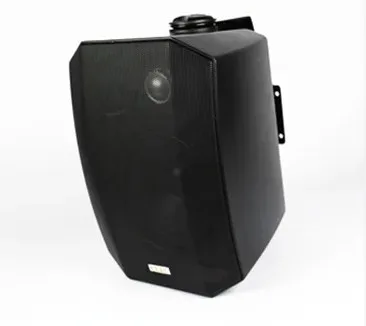
Classrooms divide between the two ordinary families. Rooms with ceilings that take flush units get ceiling speakers and an even, quiet coverage suited to speech at low level. Rooms with solid ceilings, or teaching walls that carry the lesson, get wall-mounted units — the FT-206 family is listed in the shop for schools and conference rooms precisely because so many classrooms land in the second group. Corridors and stairwells take ceiling units along their length or columns where the run is long; halls take columns for their controlled throw; the grounds take the outdoor families.
Wired or network on a campus
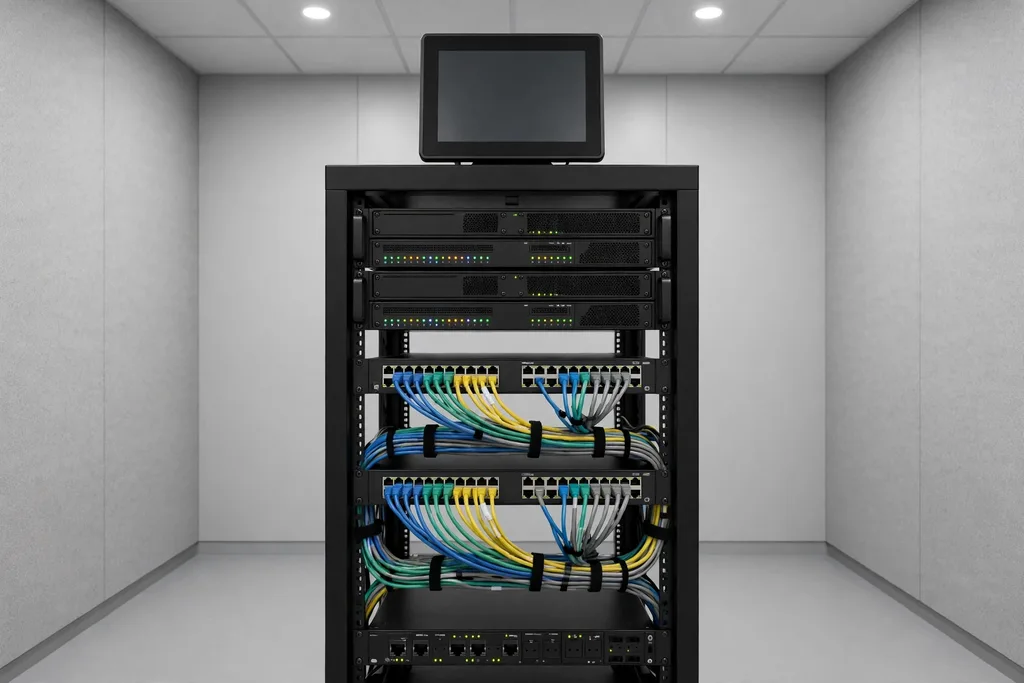
A single teaching block with short runs is served well by a wired build around an amplifier rack. The case for the IP build grows with the site: several buildings, a schedule that must be identical in all of them, grounds that would need long and vulnerable speaker cable, and a school that expects to add buildings. The comparison page works through the general trade-off; on school sites the deciding question is usually whether the system must grow, because schools do.
What a system inquiry should carry
Send the timetable, or the shape of the school day if the timetable is not final. Add the building list with rough sizes, which areas are outdoors, and which rooms must be protected from routine announcements. With those, the zones can be drawn and the equipment listed against them; quantities then describe a system rather than a pile of parts. If the school is replacing an existing system, say what the old one cannot do — the gaps in the old build are the specification of the new one.
The timetable is the specification
Everything about a school's system can be derived from its timetable, and the derivation should be done explicitly before equipment is discussed. The timetable states when zones must be silent and when they must hear; which signals are universal and which are local; where the day's exceptions live — examinations, assemblies, the half-day with its compressed pattern. A specification derived that way can be checked by the school itself, because every line traces to a moment in the school's own day. A specification that begins from equipment lists cannot be checked by anyone, and schools discover its gaps at the speed of the school year.
Sending the timetable with the inquiry is therefore the single most useful act a school buyer performs. Even a draft timetable outperforms a precise equipment list, because the equipment follows from it mechanically, while no equipment list reveals the timetable it silently assumes.
Change across the school year
A school's system is reconfigured by its calendar whether the design admits it or not: terms begin and end, examination seasons impose their quiet, holiday programmes repurpose the buildings, and September arrives with new rooms in new uses. Systems whose schedules and zones can be redrawn by the school's own staff absorb that rhythm; systems that need a technician for every change accumulate workarounds until the configuration no longer resembles anyone's intention. Buyers should weigh that operability as heavily as any electronic property, and ask how the changes they already foresee would be made, by whom, in how long.
Growth is the year's other certainty. A school that will add a block, convert a hall or absorb a neighbouring site should say so at specification time, because the host and network choices made for the present site can either welcome the addition or tax it. The welcome is cheap when planned and expensive when improvised — a pattern this catalogue's education buyers meet often enough that the sector's standard advice is simply to state the growth, even when its dates are uncertain.
Related pages
Send an inquiry
Send the timetable and the building list, and the school system can be zoned and quoted as one build.