Custom PA systems
The manufacturer offers OEM and ODM services alongside its catalogue: equipment produced to a buyer's programme, configuration or market requirements rather than taken from the standard range. This page explains what custom work covers and what an inquiry for it must specify to be quoted honestly.
What OEM and ODM mean at this factory
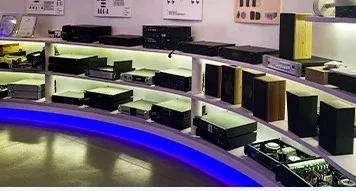
The company states that it provides customised OEM services for its customers, and its shop profile likewise offers OEM and ODM. In practical terms: OEM production manufactures to the buyer's specification and programme — the buyer's range, built by the factory. ODM work starts from the factory's existing designs and adapts them — configuration, feature set, presentation — to the buyer's market. Both are production conversations with the people who make the standard range, which is why they begin from the catalogue: the closest standard family is the reference point every adaptation is measured against.
What can be adapted
| Adaptation | Typical ground | What the inquiry specifies |
|---|---|---|
| Configuration | Zone counts, source sets, control arrangements | The system behaviour the build must deliver |
| Feature set | Scheduling, priority and interface requirements | The functions the standard model lacks, or carries unused |
| Presentation | Buyer's programme and market presentation | How the equipment must appear in the buyer's range |
| System composition | Families combined into a programme standard | The item set every site in the programme will take |
Custom work starts from a standard anchor
The fastest custom inquiries name their anchor: the standard family or model nearest to what is wanted, with the differences listed against it. That gives production something concrete to cost — a known design, a known line, a defined set of changes. An inquiry that describes only the desired end product, with no anchor, has to be reverse-engineered into the range before it can be priced, and some of what it asks for may already exist one family over. The anchor habit costs the buyer ten minutes and saves both sides a correspondence.
Quantities and honesty about them
Custom production is planned production: tooling, line time and materials are committed against the programme, so quantities and their timing are the substance of the inquiry, not a detail to settle later. Buyers should state the opening quantity and the expected pattern behind it as accurately as they can — an honest small programme is quotable, an inflated one wastes the factory's planning and the buyer's credibility in equal measure. Minimums are discussed against the specific adaptation rather than published, because they turn on what is being changed.
Custom systems as programmes
Much custom work is really standardisation: an operator or authority equipping many sites to one pattern — the same school system across a district, the same village build across a township — and wanting the pattern produced as a set. There the custom element is the composition itself, and the inquiry should describe the pattern (the site type, the standard equipment set per site) and the count of sites. The village and schools pages describe the two commonest patterns of this kind.
What custom work costs in time and attention
Customisation's price is only partly the unit price. The larger costs are time and attention: engineering exchanges to pin the variant down, samples and their evaluation, documentation in the buyer's form, and the discipline of keeping the variant's specification frozen while the project around it changes. Buyers should budget those costs as deliberately as the money, and should be wary of custom ambitions whose value has never been stated in a sentence — because the sentence, when written, sometimes reveals that the catalogue item plus a configuration choice delivers the same result without the programme. The custom conversation here begins with exactly that test, applied honestly in both directions.
Where the value survives the test, the programme's shape follows: the variant defined against the catalogue baseline, the deviations listed one by one, each with its reason. A deviation list is the custom project's constitution — samples are judged against it, production is checked against it, and later disagreements are settled by reading it. Buyers who insist on that document, however informal, protect themselves more thoroughly than any other single act.
Variants that age well, and variants that do not
Custom variants age according to where they deviate. Surface deviations — finishes, markings, packaging, documentation — age gracefully, because the underlying product continues its catalogue life and the variant rides on it. Behavioural deviations age at the speed of their difference from the catalogue: a changed function must be re-explained to every new technician, re-tested at every related change, and remembered by everyone forever. The counsel this suggests is not to avoid behavioural customisation but to spend it deliberately, on the differences the buyer's users will feel daily, and to refuse it for differences only the specification committee will ever notice.
The same logic governs quantities over the programme's life. A variant that will be reordered for years should be defined so the factory can reproduce it without archaeology — stable references, recorded settings, samples retained against the day memory fades. Establishing that reproducibility at the first order is a small cost; reconstructing it at the fourth is a project of its own.
From catalogue to custom: the staged route
Most successful custom programmes did not start as programmes. They started as a catalogue order, grew a configuration preference, then a surface variant for a repeat project type, and only later a defined product. Each stage earned the next by demonstrating the volume and the stability that customisation needs. Buyers with custom ambitions but no purchase history should consider that route seriously: it converts the manufacturer's questions from speculation into observation, and it lets the buyer's own organisation learn which deviations it actually values before paying to freeze them.
The staged route also protects the buyer's timeline. A project with a date should never depend on a first-time custom programme completing its learning curve; it should ride the catalogue, and let the custom ambition proceed in parallel for the projects that follow. Stating that separation in the inquiry — this order is standard, this conversation is custom — keeps both honest.
Related pages
Send an inquiry
Name the nearest standard family and list the differences against it, with quantities — the custom work can then be costed properly.