Public address amplifiers
The public address amplifier series is the rack at the centre of a wired broadcast build: amplifiers that take the programme sources — announcements, music, scheduled signals — and drive the loudspeaker zones. This page describes the series and the named models buyers most often list.
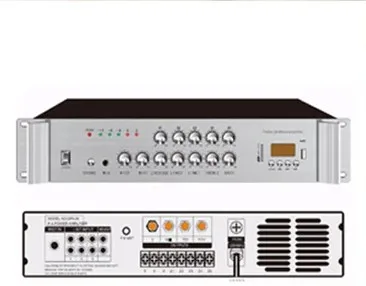
What the public address amplifier series covers
These are installation amplifiers, built to sit in a rack and run a building's sound for years rather than to be carried between events. The series serves the amplifier-and-speaker architecture described on the systems page: programme sources come in at the rack, zones go out to the loudspeakers, and the amplifier is where level, zoning and priority are physically decided. In network builds the same amplification job is done at the endpoints; in wired builds it is done here, and this series is the one buyers specify.
Named models buyers list from this series
Four names from the range appear on inquiries often enough to record here. The L-2150 is listed as a public-address power amplifier. The MTA 3.3 is a stereo PA amplifier in rack format. The ST-50 is a mini stereo amplifier for public-address systems, listed for the small end of the range — a single room or a small zone that does not justify a full rack unit. The USB-40D appears in the shop's amplifier listings as well. Model names are given as listed; ratings and detailed specifications are confirmed against the individual model at quotation stage, not republished from listing titles.
Choosing inside the series
| Question | What it decides | Where it shows up |
|---|---|---|
| How many zones? | Whether one amplifier carries the building or several share it | Zone wiring and the rack layout |
| What plays through it? | The input and mixing facilities the front panel must offer | Announcement points, music sources, scheduled signals |
| What speakers hang on it? | The load the amplifier is matched against | Constant-voltage speaker lines across the zones |
| What overrides what? | Priority handling for emergency-linked announcements | Sites with safety messaging duties |
The matching rule buyers use: an amplifier is specified against the loudspeaker load of its zones and the sources it must mix, never against the size of the building in the abstract. Two identical halls can want different amplifiers because one runs announcements only and the other runs music, paging and scheduled signals through the same rack.
Sizing a zone amplifier honestly
Amplifier sizing fails in two directions, and only one of them is visible immediately. An undersized unit announces itself: distortion at announcement peaks, protection cutting in on the loudest duty, a zone that cannot reach the far end of its ground. An oversized unit fails silently for years — capital spent on headroom never used, and a larger unit's idle draw and heat quietly taxing the rack. Honest sizing works from the zone's actual speaker count and tapping, adds the headroom the duty genuinely needs — announcements over noise need more than background music under it — and stops there, rather than doubling figures out of generalised caution.
The L-2150's place in this catalogue illustrates the intended reading: a named model is a starting point for the sizing conversation, not a substitute for it. The same zone described two ways — by its speaker schedule, or by its floor area alone — leads to different answers, and the schedule is the one to trust. Buyers who send the schedule get a model recommendation that can be checked against it; buyers who send only an area get a recommendation hedged with questions.
Rack discipline: heat, access and order
Amplifiers live in racks, and racks punish disorder. Units stacked without airflow gaps run hot and age early; cables dressed without slack turn a five-minute swap into an hour's surgery; a rack whose units are not labelled by zone turns every fault into a treasure hunt. None of this is electronics, yet it decides how the electronics age. The rack plan deserves the same care as the zone plan: ventilation space treated as a component, the most-serviced units at working height, and a label on every unit naming the ground it serves.
Heat deserves its own sentence, because it is the quiet killer in this family. A plant room that is merely warm in winter can be fierce in summer, and amplifiers sized exactly to their load have no margin for a hot room's derating. The sizing conversation and the room conversation are therefore the same conversation: tell the inquiry what room the rack lives in, and the recommendation can allow for it.
One amplifier per zone, or several zones per amplifier
The arrangement question — dedicated units against multi-zone units — is really a question about failure and about change. Dedicated units fail one zone at a time and can be re-zoned only by rewiring; multi-zone units concentrate both the convenience and the risk. Sites whose zones change often, or whose announcement patterns differ sharply zone to zone, lean one way; stable sites with uniform patterns lean the other. The catalogue carries both arrangements because both answers are right somewhere, and the sector pages show which way each setting's pattern pushes.
Cost comparisons between the arrangements mislead when they count only purchase price. The dedicated arrangement buys resilience and simplicity of understanding — any technician can trace it — while the multi-zone arrangement buys flexibility whose value depends entirely on whether the site will actually use it. A buyer who knows their site's history of change can price that flexibility honestly; a buyer guessing should usually buy the simpler arrangement and spend the difference on spares.
Related pages
Send an inquiry
Send the zone list and the sources the rack must handle, with any model names already chosen, for a quotation.