Public address systems
A public address system is the whole chain — a control point, the amplifiers, the loudspeakers and the wiring or network between them — planned as one installation. This page maps the system families in the catalogue and points to the equipment pages that fill each one out.
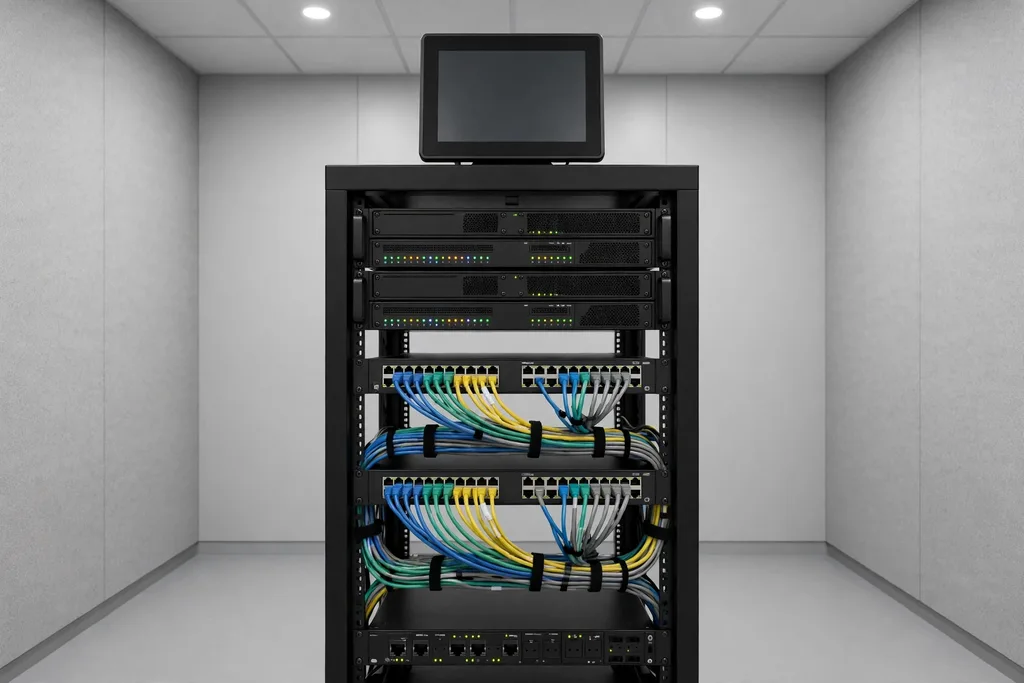
What a public address system covers: sources, zones and loudspeakers
Every system in the catalogue answers the same three questions. What plays or speaks — scheduled programmes, live announcements, background music, or all three. Where it must be heard — the whole site at once, or different zones at different times at different levels. And what carries it — in current builds, the site's own data network, with a host at the control point and loudspeakers wherever the zones are. The system families differ in how they answer the second question: how finely the site is divided, and how much of the schedule runs itself.
The system families side by side
| System family | How the site is run | Where it fits |
|---|---|---|
| IP network public address | Announcements and programmes travel over the building network to networked endpoints | Large or spread-out sites, multi-building campuses, villages |
| Intelligent public address | Timed schedules, zone programmes and automatic sequences run from the host | Schools and institutions with a daily timetable |
| Amplifier-and-speaker builds | A central amplifier rack feeds wired loudspeaker zones | Single buildings and compact sites with short cable runs |
The families are not rivals so much as sizes of answer. A single building with a handful of rooms is served well by an amplifier rack and wired speakers, and gains nothing from a network build. A campus, a hospital or a scenic area with sound points scattered across grounds is the opposite case: pulling speaker cable to every point costs more than the network equipment that replaces it, and the zoning a network gives — one garden quiet, one hall loud — is the point of the installation.
Planning a system from the setting outward
The sector pages on this site start from the setting: schools, hospitals, industrial parks, scenic areas and villages each run different announcement patterns, and the right system follows from the pattern, not from a catalogue order. Buyers planning a system rather than replacing equipment will get more from those pages than from the family tables. Buyers who already know the architecture they want can go straight to the IP and intelligent system pages, or to the equipment index for the hardware list.
How a system specification is usually built
A workable specification grows in a set order, and buyers who follow the order rarely have to revisit early decisions. It starts with the ground: a plan or a walk of the site, marking where people gather, where they pass through, and where they must never be disturbed. From the ground come the zones, drawn around use rather than around wiring convenience. From the zones come the loudspeaker positions and types, because coverage is a property of rooms and lengths, not of amplifiers. Only then does the electronics get chosen: the host or amplifier arrangement that can run those zones in the patterns the site keeps, with headroom for the loudest duty the calendar holds.
Working backwards is the common failure. A rack bought first imposes its channel count on the zoning; speakers bought on price impose their pattern on rooms they were not shaped for; and the gaps are discovered at commissioning, when changing them costs the most. The system pages on this site are written in the forward order deliberately, and the inquiry route mirrors it: describe the ground first, and the equipment conversation follows from it instead of preceding it.
Zoning decisions that shape everything else
Three zoning questions decide most of a system's character. The first is granularity: how small the independently addressable areas are. Fine granularity costs channels and configuration time; coarse granularity costs relevance, because announcements land in rooms that did not need them. The second is overlap: whether border areas belong to one zone or are deliberately covered by two, which decides how announcements behave at the seams. The third is priority: which source may interrupt which, settled before the first emergency rather than during it. None of these questions is about hardware, yet every hardware choice downstream is constrained by their answers.
Buyers who have run a site for years often answer these questions from habit without writing the answers down, and then the new system inherits assumptions nobody stated. The fix is cheap: the zone schedule in the inquiry should say, for each zone, what plays there, when, and what may interrupt it. A manufacturer reading that schedule can check the proposed host against the site's real behaviour instead of against a generic building of similar size.
Commissioning and the first month of use
A public address system is not finished when it is wired; it is finished when its levels, schedules and priorities have survived contact with the site's actual routine. Corridors that looked quiet on the plan turn out to carry delivery traffic at the hour the bell rings. A ward's quiet period collides with a neighbouring zone's announcement because a wall transmits more than the drawings suggested. The first month of use is therefore part of the design, and buyers should plan a review point in it: levels walked and adjusted zone by zone, schedules corrected against the real timetable, and the priority order tested deliberately rather than discovered.
Equipment chosen from one range makes that month easier, because adjustments are made in one configuration style across the whole site instead of in several. It also makes the review's lessons portable: a level convention settled for one building transfers to the next building the buyer fits out, which is one of the quieter reasons institutional buyers standardise on a single manufacturer's system family.
Related pages
Send an inquiry
Describe the site and the announcements it must carry, and the system can be sorted into an equipment list for quotation.