Public address speakers
Public address speakers are the install category in the company's shop range: loudspeakers specified for announcement and programme duty in buildings, chosen by placement and coverage rather than by appearance. This page explains how the category relates to the individual speaker families.
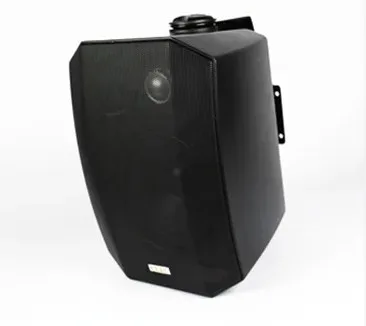
What the public address speaker category covers
In the shop's own organisation, public address speakers are the general install line, sitting alongside the PA speaker header and distinct from the specialised series. In practice the category covers the loudspeakers that fill the ordinary rooms of an ordinary building — the classrooms, offices, corridors, wards and halls where most announcements are actually heard — while the named series (column, waterproof column, garden, horn) handle the placements with special demands. A project order usually draws on both: category speakers for the rooms, series speakers for the difficult ground.
Announcement duty shapes the choice
A public address speaker is judged first on speech. Announcements must stay intelligible at the level the room is run at, through the room's own noise, for a listener who is not facing the speaker and not expecting the message. That is a different test from music reproduction, and it is why the category exists separately from the professional audio series: the professional series is specified for programme quality at working levels, the public address category for clarity of the spoken word across a working building.
Ordering from this category
Category orders are normally placed by room schedule: the rooms listed by type, the speaker count per room, and the system the speakers hang on. Where a room schedule does not exist yet, the family pages are the better starting point — pick the family per placement, then return here with the counts. Replacement orders should name the units being replaced or describe them by placement and size, so the match lands in the same family.
The speech-first test
Public address speakers earn their keep on speech, and speech makes a specific demand: consonants must survive. Vowels carry loudness, but understanding rides on the quieter, higher components that state the difference between one word and the next. A speaker that sounds full and warm on music can still fail an announcement if those components are smeared by the room or missing from the unit. Buyers auditioning or comparing should therefore use speech — recorded announcements, a voice at a microphone — as the test material, and treat music demonstrations as evidence about a different quality than the one being bought.
The room is the other half of the test. Reverberation attacks exactly the components speech depends on, which is why speaker pattern — how tightly the sound is aimed at listeners and kept off walls and ceilings — matters as much as the unit's own quality in real buildings. The long, hard-surfaced spaces that dominate public address work reward narrow, controlled patterns; the small, soft rooms forgive almost anything.
Announcements against background music: one system, two duties
Most public address speakers serve two duties with opposite manners: music that should sit under conversation, and announcements that must cut through it. The system handles the contradiction with ducking and zone levels, but the speakers themselves must be capable at both ends — clean at the low level music lives at, composed at the level an announcement needs. A unit chosen for only one duty betrays the other daily. Buyers describing their site should state both duties plainly, including which zones are music-led and which are announcement-led, because the answer steers family choice room by room.
The balance also shifts across the day in many settings — the retail floor that is music-led at noon and announcement-led at closing, the station that reverses by the hour. Where the pattern is known, it belongs in the inquiry; the zone and schedule design can then be shaped around it instead of against it.
Finishes, fixings and the building's opinion
Speakers are the visible part of a public address system, and buildings have opinions about them. Listed interiors, designed retail spaces and places of worship will each reject units that a warehouse accepts without thought, and the rejection arrives late if the finish conversation is left late. Buyers should establish early which positions are architecturally sensitive, what colours and profiles are acceptable there, and whether recessed or surface mounting is permitted — then let the acoustic design work inside those constraints, which it nearly always can when they are known in time.
Fixings carry a safety dimension that finishes do not: overhead units must be secured against falling, outdoor units against wind and interference, and every fixing chosen for the material it actually anchors to. The inquiry that names its ceiling and wall construction lets those choices be made on paper; the one that omits it leaves them to be improvised on a ladder.
Related pages

Send an inquiry
Send the room schedule or the placement list, and the category can be turned into counts per family for quotation.