IP PA system vs analog
The choice between an IP public address system and a conventional wired (analog) build is the first architecture decision in most projects. Neither is the modern-or-old version of the other: they are two ways of carrying sound that suit different sites. This page compares them on the points buyers actually decide on.
The difference in one paragraph each
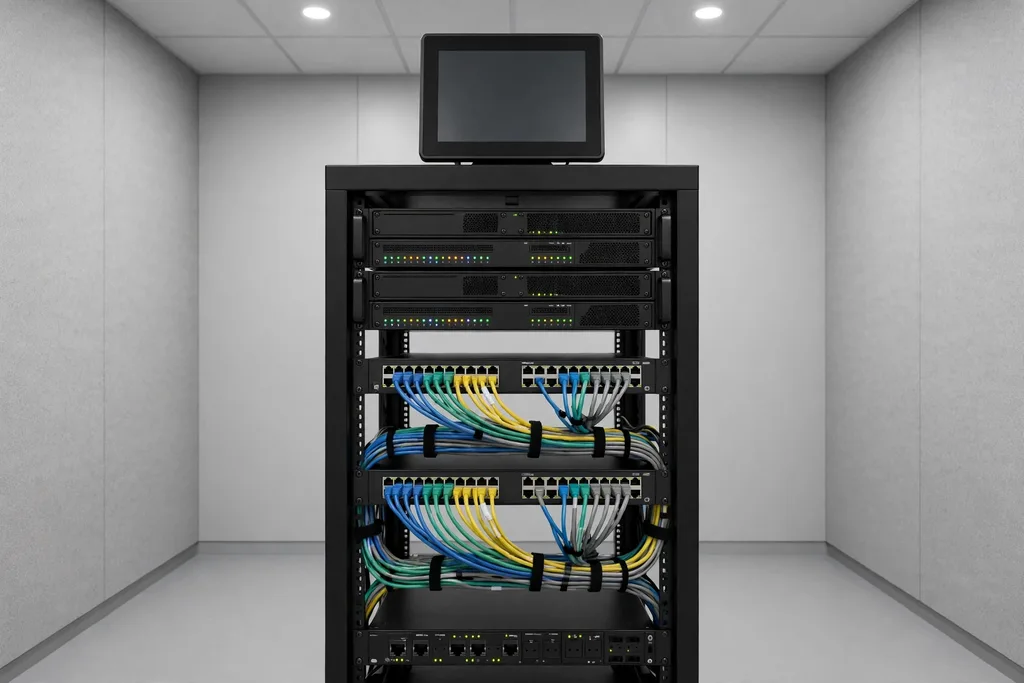
An analog build carries sound as an electrical signal over dedicated speaker cable. A central rack holds the amplifiers; each zone is a cable run; the system's shape is literally wired into the building. An IP build carries sound as data over the site's network. A host serves networked endpoints — amplifiers, terminals, speakers — wherever the network reaches, and the system's shape lives in configuration: zones, schedules and control points are settings, revisable without touching a cable. Everything in the comparison below follows from that single difference.
Side by side
| Decision point | IP (network) build | Analog (wired) build |
|---|---|---|
| Cabling | Rides the existing data network; new points are network points | Dedicated speaker cable to every zone |
| Zoning | Set and reset in configuration | Set by the cable runs; changes mean rewiring |
| Expansion | Add endpoints where the network reaches | Add cable runs, possibly a bigger rack |
| Control points | Anywhere on the network; several are easy | Where the rack and its wiring allow |
| Distance | Network distances: buildings, campuses, settlements | Cable-run distances: a building, a compact site |
| Failure shape | Depends on the network's health | Depends on cable and rack; a cut run silences its zone |
| First cost shape | Endpoints and host; little cabling | Amplifiers and speakers; cabling labour on top |
Where analog is the right answer
A compact, stable site is analog's home ground. One building, a handful of zones, no expectation of growth or rearrangement: the wired build is simpler, its parts are fewer, and its behaviour is transparent to any electrician who maintains it. Schools in a single block, small clinics, single-floor workplaces — these take an amplifier rack and wired speakers and never feel the absence of a network. Choosing IP there buys flexibility the site will never spend.
Where IP is the right answer
Distance and change make the network case. Several buildings, grounds where cable would cross open or landscaped ground, settlements spread along streets: the network removes the cabling problem by using infrastructure that already crosses the site. Change makes the second case: zones redrawn by term or season, areas opening and closing, control points moving with duty staff. Hospitals, campuses, scenic areas and villages — the catalogue's network sectors — share one of those two traits, and usually both.
The hybrid most sites actually build
Real projects often land between the poles: a network backbone between buildings or across a site, with wired zones inside each building served by local amplification. That is not a compromise but a matching of each layer to its ground — network where distance and change dominate, wired where runs are short and stable. An inquiry does not need to settle the split in advance; it needs to describe the site honestly — buildings, distances, growth — and let the architecture be drawn from it.
Migration paths: living with both during transition
Real sites rarely switch architectures in a single act; they migrate, and the migration's quality decides how the comparison is remembered. A phased migration — new buildings born networked, old buildings converted as they renovate — lives with both architectures for years, and the living-together has requirements: a control position that can address both, announcement habits that do not depend on which system a zone sits on, documentation that states plainly which ground belongs to which architecture. Buyers planning a migration should specify the transitional state as deliberately as the destination, because the transition is the state their users will actually inhabit for most of the system's early life.
The phased route also spreads the comparison's risks. Each converted building is a referendum on the new architecture conducted with the old one still running beside it; a disappointed phase can be paused, an impressed one accelerated. Big-bang conversions offer no such evidence until everything depends on them.
Total cost across the system's life
Purchase prices compare the architectures at their least representative moment. Across a system's life the ledger fills with other entries: the rewiring each reorganisation costs the conventional system and spares the networked one; the network preparation and configuration care the IP system draws and the conventional one never needs; the spares shelves, similar for both; the staff skills each demands. Sites that reorganise often, span far, or renovate in phases will find the lifetime ledger leaning one way; compact stable sites will find it leaning the other or arriving level, in which case the decision rightly falls to secondary matters — the skills on hand, the growth foreseen, the buyer's own preference for where complexity should live.
Honest lifetime comparison also prices the cost of being wrong asymmetrically. An underspecified network can be extended socket by socket; an underspecified wired system is extended with building work. Where the future is genuinely uncertain, that asymmetry is a rational tie-breaker, and it belongs in the comparison beside the figures.
Related pages
Send an inquiry
Describe the site — buildings, distances, expected change — and the architecture can be recommended against it, wired, network or both.