Choosing column speakers for outdoor broadcast areas
Outdoor broadcast fails quietly: the announcement is clear at the speaker and gone twenty paces later. Column speakers exist to prevent exactly that. This guide explains how their throw works outdoors and how to place them along paths, squares and waterfronts.
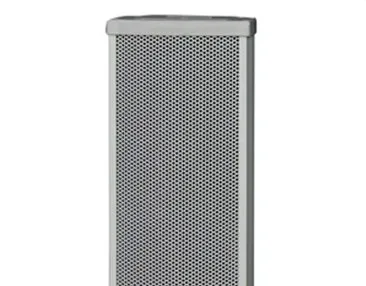
The outdoor problem is pattern, not power
Buyers meeting outdoor sound for the first time usually reach for power: the area is big, the listeners are far, so the speaker should be louder. Outdoors, loudness at the speaker is nearly free and nearly useless. There are no walls or ceiling to return the sound, so whatever leaves the pattern is lost; wind and ambient noise take their share; and the listener at the far end receives only what the pattern actually delivered along the ground. The specification that matters is the coverage pattern — where the sound goes — and that is a property of the loudspeaker's shape, which is why the tall, slim column is the outdoor tool.
How a column throws
A column's drivers stand in a vertical line. Driven together, they project sound forward in a pattern that is wide across the line of the throw and tight vertically — the energy goes along the ground toward the listeners instead of up into the sky and down into the paving. Two consequences follow. The level falls off more gently with distance than from a point source, so near and far listeners hear something closer to the same announcement. And the sound stays in the layer where people are, which outdoors also means it competes better with the noise that lives there. Mounted at one end of a path or along its side at intervals, columns cover lengths that would need a scattering of ordinary speakers — each of which would be loud beside itself and quiet between.
Placement along real ground
Work along the route the listeners take. On a straight path, columns at intervals, each covering the stretch to the next, give even coverage at walking level; at a bend or a fork, a column at the junction covers the decision point where guidance matters most. On a waterfront or a square, columns at the perimeter aim inward, so the crowd area is covered from its edges and the centre stays free of hardware. Height follows the ground: high enough to clear heads and planting, low enough that the throw stays in the listening layer. The mounting — pole or building — is chosen per position, and the positions belong in the inquiry, because the count and the spacing come from them.
Weather is a specification, not a hope
Outdoor positions in this catalogue belong to the waterproof series, and the distinction matters when an inquiry is assembled. An indoor column moved outdoors will work — briefly, and then seasonally, and then not. The waterproof series is built for exposed positions as its normal condition. Sheltered positions — deep eaves, covered walkways — are the honest middle ground where standard equipment can serve, and the inquiry should describe the shelter accurately rather than generously: a position the rain reaches at an angle is an outdoor position for specification purposes.
Columns and garden speakers divide the site
On a scenic or landscaped site, columns take the structured ground — paths, waterfronts, squares — and garden speakers take the planted ground between them, where sound should arrive gently and the hardware should disappear into the landscaping. Specifying columns everywhere overshoots the gardens and puts poles in the flowerbeds; specifying garden speakers everywhere leaves the main path under-covered. The site list that divides its areas between the two families, area by area, is the one that comes back as a system rather than a compromise.
What to send
Path lengths and the shape of the open areas. The positions available for poles or mounting. Which areas are exposed and which are sheltered, described honestly. And the quiet areas — every outdoor site has them, and the column's controlled throw is as useful for keeping sound out of a place as for putting it into one.
Listening from the last bench
Outdoor column installations should be judged from the worst seat, not the best: the bench at the throw's far end, the path's furthest bend, the standing place behind the fountain's noise. Designers who listen there discover the installation's truths — the end wall returning a slap of echo, the gap where two columns' coverage fails to meet, the level that was generous at the unit and adequate nowhere else. The adjustment session that follows a worst-seat listen is the highest-value hour in the commissioning, and buyers supervising an outdoor installation should insist the hour happens in their presence, at the hour of day the system will actually work.
Weather joins the listening test outdoors. Wind moves sound bodily; a beam aimed true in still air bends on a breezy afternoon, and a site that hosts ceremonies should know its system's behaviour in the site's ordinary weather, not only in the calm of the installation morning. None of this argues against outdoor columns — it argues for commissioning them as outdoor things, in the conditions they were bought for.
Columns among the other outdoor families
Outdoor briefs rarely belong to one family alone, and the column's neighbours deserve their places in the same plan. Horns take the wide, noisy, distant ground where a beam of speech must be thrown across activity. Garden units take the close, quiet, landscaped ground where sound should feel local. Columns take the lengths — the paths, promenades and covered ways where people are distributed along a line and the programme must travel with them. A site plan that assigns each family its ground, and draws the seams where their coverage meets, is the mark of an outdoor design rather than an outdoor purchase, and buyers reading a proposal should look for the assignment before they look at the totals.
The seams matter because outdoor listeners move through them continuously, unlike indoor listeners who mostly sit inside one family's territory. A level or tone mismatch that an office worker would never notice becomes, on a promenade, a small repeated announcement that the system was assembled rather than designed.
A final word on quantities, because outdoor column runs invite a particular error: covering a length twice because the first design was never listened to. The disciplined sequence is to install the designed run, walk it at working hours, and only then decide whether the gaps the walk found are real or were artefacts of a quiet morning. Columns added after that walk land where the evidence puts them; columns added before it land where anxiety puts them, and anxiety is a poor acoustician. The same discipline, applied to levels, keeps outdoor systems welcome in the neighbourhoods they serve — which, over a system's life, is a technical property as real as any in the catalogue.
Related pages

Send an inquiry
Send the path lengths and positions, and the outdoor coverage can be laid out column by column.