PA paging in hospitals: running announcements over the building network
Hospital paging has to satisfy two masters: the call that must reach a person anywhere, immediately, and the patient for whom the building's noise is part of the illness. This guide explains how a network system holds both duties at once.
The ward is the specification
Every design decision in hospital paging is downstream of one fact: in the wards, sound is a clinical variable. Patients rest badly in noise; staff work worse in it; and a paging system that treats a ward like a railway concourse will be resisted, turned down, and eventually defeated by the people it serves — the worst outcome a safety-relevant system can have. So the design begins from the protected zones and works outward: what may enter a ward, at what level, under whose authority. Everything else — the public areas, the staff zones, the control points — is arranged around that protected core.
Why the building network carries it
Hospitals are the most reconfigured buildings in ordinary use. Wards change specialty, departments trade floors, wings open and mothball. A wired paging system's zones are its cable runs, so each reconfiguration is a small building project inside a working hospital. A network system's zones are configuration: endpoints addressed by the network, grouped and regrouped as the building's use changes, with the control points placed wherever the duty staff actually sit. That revisability is the network's real argument in this setting — stronger even than its installation convenience — because a hospital system will be rezoned more times in its life than any other building's.
Levels: the quiet end of the fader
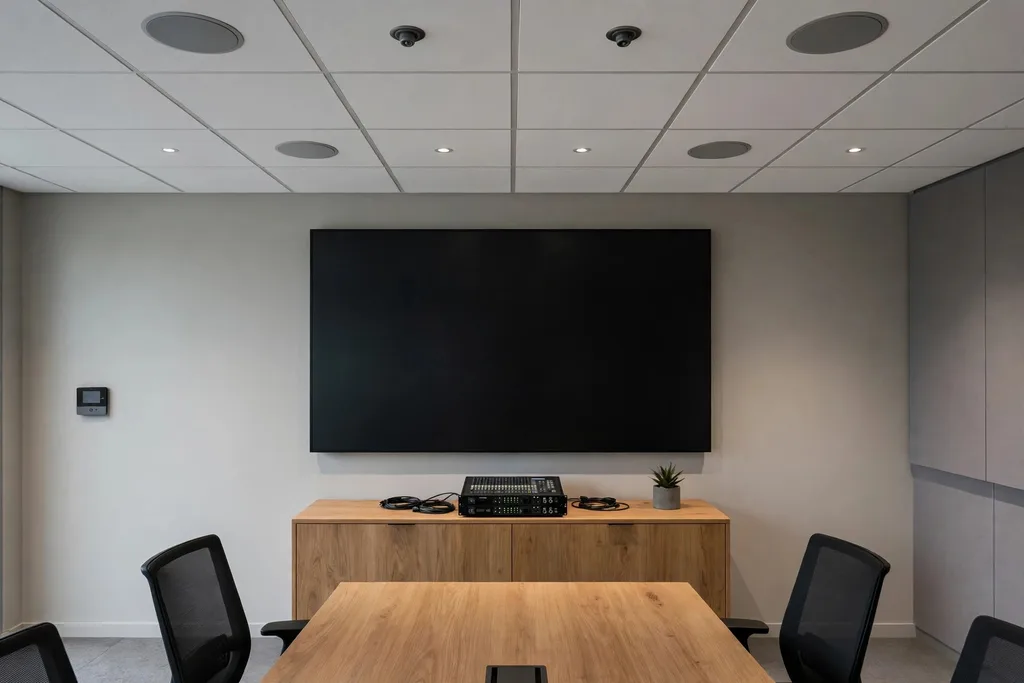
Paging levels in clinical areas are set from the bed outward. The question is never how loud the system can be but how low it can run while remaining intelligible to the person it addresses — a staff member who knows a call may come, listening for it, in a room whose ambient level is low. Speaker choice serves that: ceiling units give even, local, low-level coverage, each patient close under a speaker rather than far from a loud one. Public areas run at public levels, and the system's zone discipline is what keeps the two regimes from leaking into each other through an open door of configuration.
Priority without panic
The emergency layer must override everything, everywhere, instantly — and the routine layer must never borrow its authority. Systems get this wrong by making too many call types urgent, until urgency is the building's background and staff stop startling at it. The design discipline is a short priority list, ruthlessly kept: genuine emergencies at the top with full override; urgent staff calls beneath, reaching staff zones and protected areas at controlled level; routine paging at the bottom, confined to public and staff zones. Each tier's reach is a configuration fact, reviewed when departments move, not a habit the operators are trusted to remember.
Control points follow the duty, not the rack
In a wired build the control point lives with the equipment. In a network build it lives with the people: the admissions desk by day, the night supervisor's office by night, a second point for the emergency team's floor. Permissions follow the same logic — a department can page its own zones, the duty desk can page the building, the emergency function can page everything. Setting this matrix is administrative work at commissioning, and it is worth doing deliberately, because a paging system whose permissions are wrong teaches its users to work around it, and workarounds in a safety system are how calls get missed.
What the hospital inquiry should describe
Departments grouped by duty: public, staff, protected. The emergency messaging obligation, stated plainly. Control points by day and night. Ceiling construction on the clinical floors, for the speaker plan. And the reconfiguration habit of the building — how often areas change use — because that, more than size, is what decides how much of the design's weight the network layer should carry.
The page that must never wait
Every hospital paging design contains one message class that outranks all others — the emergency call — and the design should be auditable from that message's point of view. Trace it: where it originates, what it interrupts, which zones it enters, what level it assumes, what happens if the usual origin point is unmanned. The trace is a short document and an uncomfortable one, because it exposes the assumptions the everyday system makes casually — that the desk is staffed, that the schedule yields, that the zone map as configured matches the zone map as intended. Buyers responsible for a hospital system should hold that document and review it when anything in the building changes, because the everyday system will be forgiven its faults and the emergency path will not.
Testing the path belongs to the same discipline. A priority system that has never been deliberately exercised is a hypothesis, and hospitals are not places for hypotheses about emergency communication. The test need not disturb patients — scheduled, announced, at a quiet hour — but it must happen, and its result must be recorded beside the trace it verified.
Visitors, patients and the two audiences
Hospital paging addresses two audiences with opposing needs sharing one building. Visitors need direction — clear, frequent, reassuring — in the public areas they move through. Patients need rest, and their areas should receive only what concerns them. Systems that treat the building as one audience fail both: the public areas go under-informed while the wards go over-announced. The zone discipline that separates the audiences is therefore not a refinement but the system's core competence, and it should be visible in any design a hospital is offered: public zones carrying the visitor programme generously, clinical zones carrying almost nothing that is not theirs, and the boundary between them drawn where the building's own life draws it.
The boundary moves across the day — visiting hours flood the wards' edges with the public audience — and a thoughtful design lets the pattern move with it, under the schedule's control rather than the staff's improvisation.
Underneath every section of this guide sits one principle worth stating plainly: in a hospital, attention is a clinical resource, and the paging system is one of its largest spenders. Every unnecessary announcement spends attention that a nurse, a doctor or a frightened patient needed for something else; every necessary one that fails to arrive spends something worse. Designs that respect the resource — precise zones, honest priorities, levels set by listening in the wards themselves — repay their care daily and invisibly. Designs that waste it are resented daily and visibly, by exactly the people the hospital can least afford to burden. The equipment is the easy part of that bargain; the discipline is the purchase.
Related pages
Send an inquiry
Describe the departments by paging duty, and the hospital system can be designed around its quiet areas first.